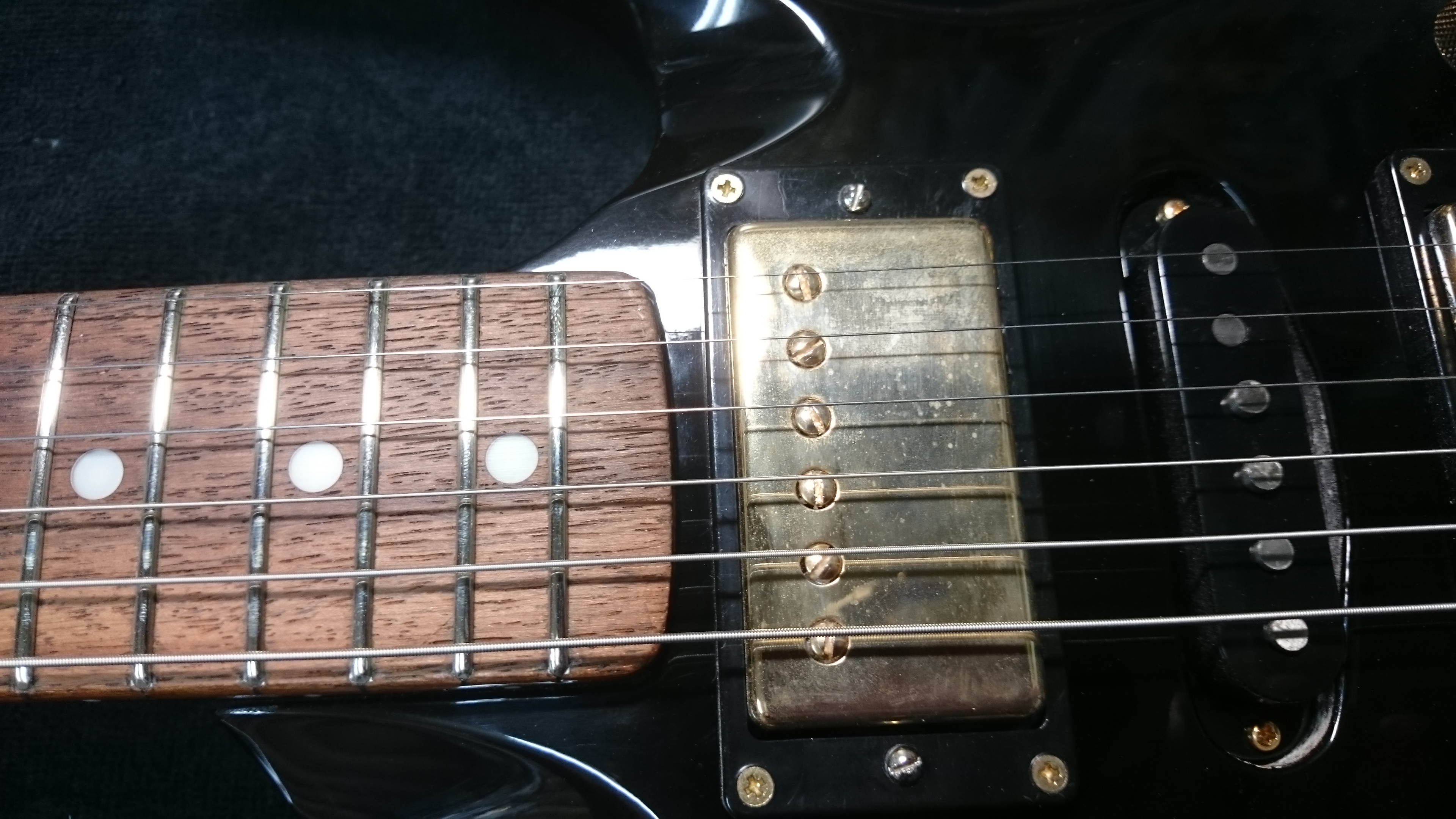
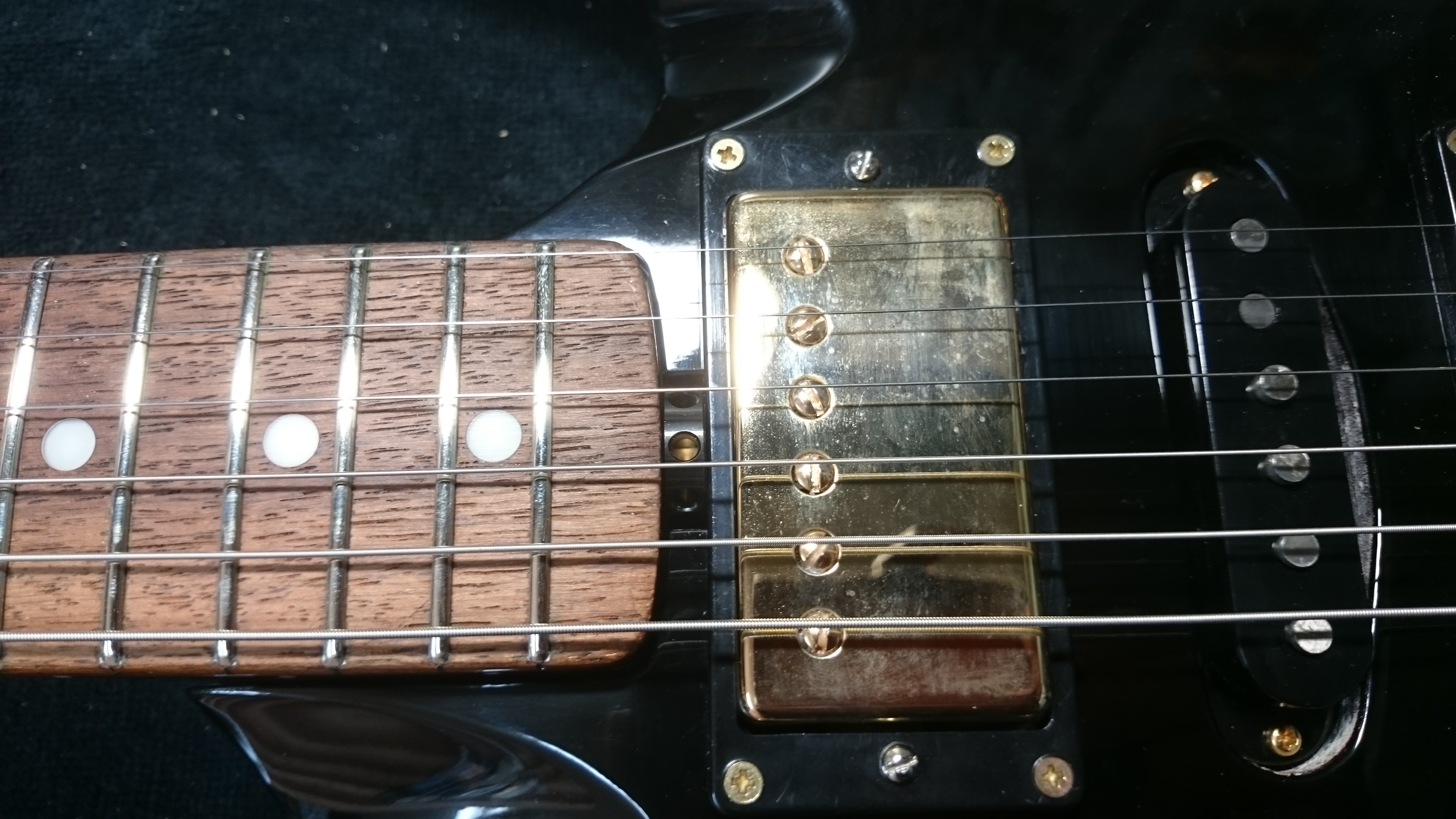
I feel like the strings on my guitar are getting too high lately…” ”Some frets are getting a little jumpy…”
Hello, guitar players! My name is Murayoshi of DNS Guitar.
As you pick up your guitar every day, do you ever notice such trivial changes? It might be an SOS from your guitar!
In this issue, we have compiled a list of things you should know about the truss rod, which plays an important role as an adjustment mechanism to maintain the health of the neck, the super-important part of a guitar.
You may be thinking, “Truss rod? What’s that? and “Is it safe to do the adjustment by myself? This article will surely help you understand the importance of the truss rod. Please read this article to the end so that you can keep your beloved guitar in proper condition and enjoy playing at its best forever!
~ The backbone of the guitar! What is a truss rod? ~ What is a truss rod?
First of all, let us answer the question, “What in the world is a truss rod?” First, let’s answer the question, “What exactly is a truss rod?
A truss rod is a rod installed in the center of the neck of a guitar that adjusts the warp of the neck.
It is mainly used to correct the warping of the neck caused by the tension of the strings (in the direction of the strings).
Guitar necks are made of wood and are exposed to strong string tension.
If left unattended, the neck will gradually bend in the forward direction, making the strings higher, harder to play, or in the worst case, impairing your playing.
This is where the truss rod comes in! By turning and adjusting the rod, the warped neck can be corrected and kept in proper condition. It is truly the “backbone” of the guitar.
~Why is it necessary to adjust the truss rod? What happens if it is neglected? ~What happens if it is neglected?
So why is it necessary to adjust the truss rod? What will happen to the guitar if it is neglected?
String Height Change: As the neck warps, the distance between the strings and frets (string height) changes. Forward warping results in higher string height, which makes it more difficult to hold the strings and makes the fingers more tired. If the strings are warped backward, the string height becomes too low, making the strings more likely to hit the frets, causing clogging and chattering.
Playability: If the string height is not appropriate, smooth fingering and picking will be difficult, and playability will deteriorate significantly. For beginner guitarists, it can be painful to play.
Deterioration of sound: If the strings are not set at the correct height, the guitar will not be able to play well enough, and the sound that can be produced by the guitar will be lost and the sustain will be compromised.
In the worst case scenario, the neck may not be able to be fixed by adjusting the truss rod alone. Proper maintenance is essential for the longevity of your precious guitar.
In other words, truss rod adjustment is very important maintenance to maintain playing comfort, to bring out the original sound of the guitar, and to prolong the life of the guitar itself.
~ Don’t miss the signs that it’s time to adjust the truss rod! ~ Don’t miss the signs that it’s time to adjust the truss rod!
So when is it time to adjust the truss rod? Guitars send us various signs. If you notice any of the following, consider adjusting the truss rod.
The string height feels higher (or lower) than before. →The previous state of warping has changed.
The strings are clogged or chattering at a particular fret. →If the neck is warped in the opposite direction, consider adjusting the fretboard.
The neck is warped in the opposite direction (the center of the fingerboard is swollen, making it difficult for the strings to sound). →The string height becomes low and the sound is easily choked.
The neck is warped inward (the center of the fingerboard is concave). →The string height is too high, making it difficult to play.
After temperature or humidity changes, such as during the changing of seasons. →The environment in which the wood is most likely to deform.
It is very important to take appropriate measures as soon as possible without overlooking these signs in order to maintain the health of your guitar.
~Can I adjust the truss rod by myself? What should I pay attention to? ~ “I want to adjust the truss rod by myself.
Some of you may be thinking, “I want to adjust the truss rod myself!” You may be thinking, “I want to adjust the truss rod by myself! Certainly, it is possible to adjust the truss rod yourself if you have the proper knowledge and tools.
However, if you do it with an easy mind, you may cause fatal damage to your guitar.
If you do the adjustment yourself, please pay close attention to the following points.
Use the proper tool: The size and shape of the wrench you use depends on the type of truss rod. Use of an incorrect tool may damage the rod or nut.
If you turn it too much at once, it will be difficult to find the right point.
Do not force: If the nut is too stiff to turn, do not force it. If you turn it too hard, it may break, so we recommend you to consult a repairman.
Do not adjust in the wrong direction: Tightening and loosening the truss rod in the wrong direction can worsen the condition of the neck. Generally speaking, turning the truss rod clockwise from the head side will adjust the neck in the reverse direction, while turning it counterclockwise will adjust it in the forward direction, but be aware that this may vary depending on the type of guitar.
If you have any doubts at all, we recommend that you do not hesitate to contact a repairman.
At DNS Guitar, our experienced repair staff will accurately diagnose the condition of your guitar’s neck and adjust it to the optimum condition!
~ Summary~.
The truss rod is an adjustment mechanism that plays an important role in ensuring that your guitar performs at its best and can be used for a long time.
Proper maintenance and keeping your eyes and ears open for SOS signs from your guitar will help protect your precious guitar.
If you are at all concerned about the neck of your guitar, please do not hesitate to contact DNS Guitar. We will provide you with the best advice and maintenance from the perspective of a professional repairman.
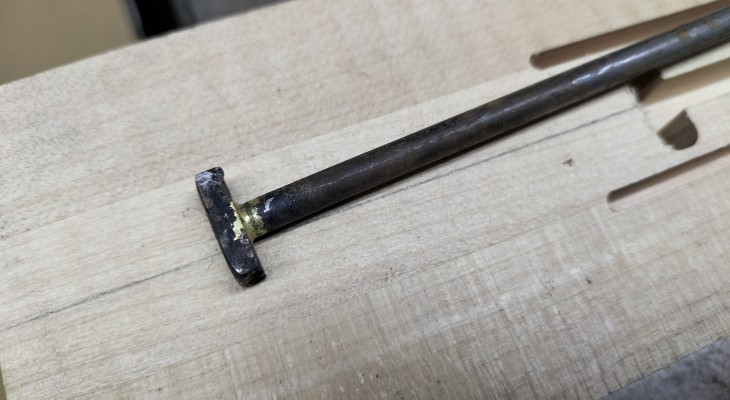
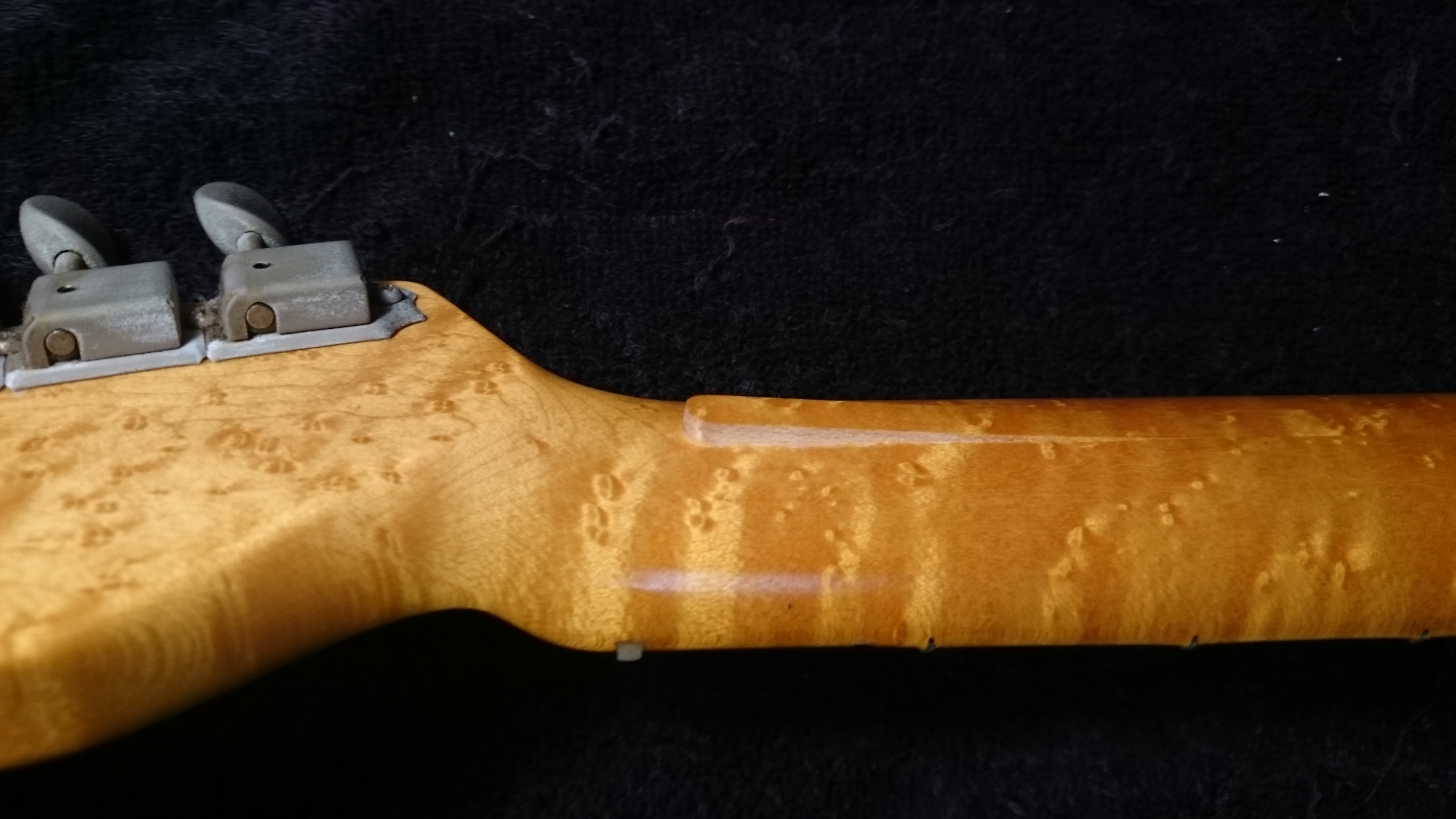
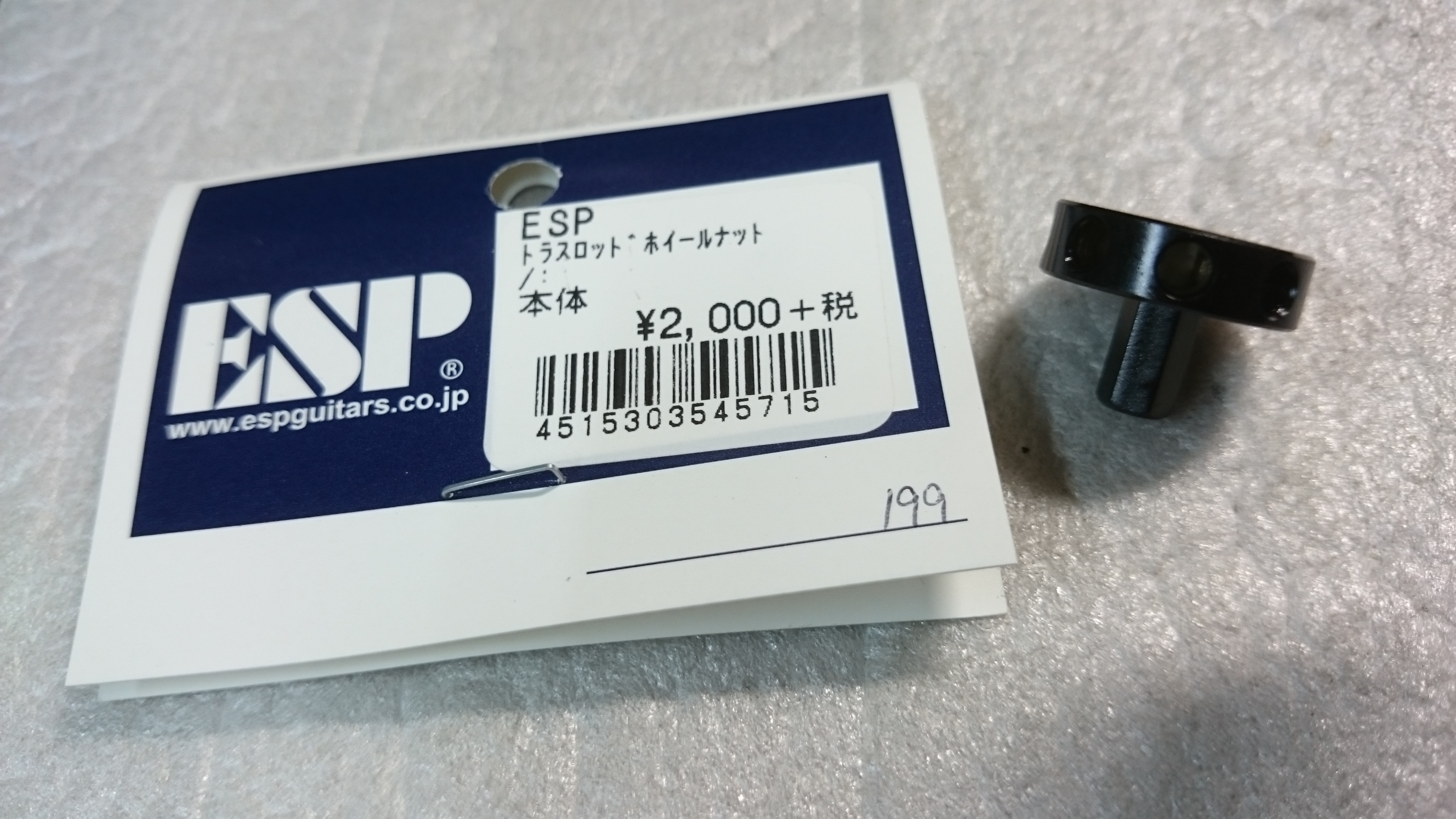
The customer made a mistake and made the nut opening of the truss rod to be snapped off.
We can’t do much work to fix it, but when we checked it, we found that only the entrance area of the nut was snagged because he didn’t put the tool in deep enough when he turned it.
This is one of the reasons why the tool does not go all the way in.
After some work, it was able to go all the way in and can be turned if the tool is inserted all the way in, but there is still some concern because of this original condition.
Also, because the truss rod is double-acting, it is not possible to replace the nut alone.
It is easy for amateurs to jam the truss rod, especially if the truss rod has no room and is hard to turn.
It is important to check the amount of truss rod left before purchase.
If there is a large amount of truss rod left, the turning force does not need to be as strong, so there is less danger of the truss rod being jammed.
In recent years, even new instruments are often sold with a small amount of truss rod left over or at the limit, and it is more dangerous to buy them at a music shop because they are not marked with this information at all.
Please make sure to ask the shopkeeper how much truss rod is left before you buy, and be sure to have the shopkeeper turn the truss rod in front of you to check.
Also, a music shop that tells you that you can leave the strings taut and that the reason for this is because “the tension of the truss rod balances the strings” is a minefield.
These words reveal a lack of knowledge, so please do not buy from such a music shop.
After-sales service after purchase is also very difficult due to lack of knowledge, so be careful.
The controversy still rages to this day, “Should I loosen the strings? Should I leave the strings taut?” I don’t know how long it will continue.
I don’t know how long it will continue, but things like this, where the answer is not clear, can be said and deceived as much as possible, and the business model of deceiving people comes in.
In the end, it is the people with weak information who are deceived, so the only way to protect yourself is to study and defend yourself.
In Japan, the media brainwashing is particularly strong, and people take for granted that whatever a famous person or a big company says is right, no matter who says it.
To put it bluntly, we are all idiots, and until that is cured, bad companies will not disappear.
It is better to fix their attitude of blaming others when something happens, putting the blame on others and never growing up.
The people are to blame for everything. They need to study and have the ability to recognize what is wrong and have an attitude of not following what is wrong.
If everyone could act on this, bad companies would not survive and would perish. And only the truly good companies will remain in our society.
~The answer is already out there.
As I have been saying for a long time, all the places involved in musical instruments should disclose the facts about what is happening in repair stores.
Perhaps I am the only one.
The reason for this is simple: many repair stores are not willing to say what is inconvenient for their business partners, so they keep quiet.
Also, because they have been making ignorant statements for a long time and cannot say “I was wrong” now.
The answer came out around the 80’s when modulus was introduced and carbon necks were adopted.
Carbon necks are harder than wood and have excellent stability against moisture and drying due to man-made materials. When modulus came out, it was assumed that carbon necks would not warp, and no truss rod was put in at first, but as a result, a truss rod was put in.
This is already the answer.
The tension of the strings is so strong that the neck is not structured to withstand the force, so the neck bends under the tension of the strings.
The strings must be loosened, and the reason for this is that the instrument is physically beyond the range of load it can withstand.
This is because the structure cannot withstand the great load of string tension for many years, and also because I have seen many instruments in poor condition.
If it were okay to leave the strings in place, there would be few instruments in bad condition, but the majority of the world’s instruments are in bad condition.
If you are in the field dealing with such instruments, you will understand this story even more, and there are only two choices: either you know it and don’t say it, or you know it but are an amateur who doesn’t understand it.
Loosening the strings or not? I have talked about this in past blog posts and on Youtube, so please refer to those for more details.
It would be tedious to repeat the same story I have told in the past here, so you should study it by yourself.
If the amount of excess is large or close to 100%, you can say that the strings should be left taut because you will be in trouble if they warp backwards (in the case of a 1-way truss rod), but it is rare to find an instrument in such a good condition.
Most instruments have a truss rod that is closer to the limit of its tension than it is to the limit of its looseness.
Adjust the amount of loosening by looking at the amount of excess.
If you cannot say that the truss rod should be left taut or loosened after checking the amount of excess in these operations, it is no good.
If you do this for many instruments, you will not see instruments with truss rods with nearly 100% excess, so the percentage of “strings should be loosened” is much higher.
The basic premise for storing items related to wood is to keep the humidity above a certain level to prevent them from drying out.
~Example
Truss rod limit → Loosen the strings to a dull dull state where no tension is generated, and you will be lucky if the truss rod warps the strings backwards.
If you want to increase the amount of truss-rod excess, you should lower it by 1 1/2 to 2 1/2 notes. If you want to increase the amount of excess at this time, you should make the truss rod as dull as above and be lucky if it warps backwards, or you can keep it half to one note lower when the amount of excess increases.
If you want to increase the amount of excess in this case, you are lucky if it is inverted, but if you want to increase the amount of excess in this case, you should keep the strings taut. (ideal condition for an instrument, but in reality there is very little)
~ Why am I so picky about the amount of extra truss rod? ~ Why am I so picky about the amount of truss rod excess?
The amount of truss rod left over is very important because it directly affects the “life” of the instrument.
Basically, an instrument can be made to last a lifetime.
The reason why this is not possible is because of severe forward warping.
If there is an excess amount of truss rod, the warp can be corrected and the instrument can be used as usual, but the range in which this truss rod can be used is “finite. It does not mean that it can be used indefinitely.
In other words, if you want to use the instrument for a lifetime, it is very important to keep the neck from warping. It is very important to keep the neck from warping.
Of course, you may be asking yourself, “Can’t I just replace the truss rod? Do not ask the silly question, “Can’t I just replace the truss rod?
As long as the truss rod is left over and the neck is not warped, the instrument can be used for a lifetime.
You can replace nuts, frets, and other consumables, and you can adjust the adjustment mechanism in any way you like, but truss rod adjustment is finite, and the life of the instrument is to keep the truss rod from bowing out.
The amount of truss rod left over = the life of the instrument.
Do you understand how bad it is to sell a new instrument with a small amount of truss rod left over or at the limit of the amount of truss rod left over because the wood has become soft in recent years?
In other words, even expensive products are sold in a condition where they will not last long and cannot be used for many years in the future because they are in such a bad condition from the beginning.
That is why you have to make sure that you check the condition of the product before you buy it.
Of course, we don’t know what the future holds for new products, but we can predict that they will not have a future by looking at their initial condition.
For example, if you buy a 2000 instrument in 2025 and it has a lot of truss rod left over, you can be sure that the instrument has survived 25 years in good condition and will continue to be used for 25 years.
But I have been giving this information for a long time, and it is common sense to say the least.
I think it is a delicate range to complain if the instrument you bought is in poor condition or otherwise damaged.
It is the customer’s fault for trusting a music shop that does not disclose the condition of the instrument, even if it is a new one, without questioning it.
Therefore, the customer should be angry at the store and say, “Make a detailed description of the condition of the instrument! The customer should be angry with the shop.
The reason why our society has become the way it is today is because we don’t do that, we don’t try to change the current situation, and we don’t take action.
~ The important thing is wood strength~.
Many idiots who say that “strings should be left taut” reason that “the force of the truss rod balances out the warping,” but this is completely ludicrous.
For example, the modulus mentioned above has a model without a truss rod, and there is a reason why there is a manufacturer “Vigier” that does not have a truss rod in their current products, and there are also acoustic guitars (Martin, etc.) that reproduce old models that do not have a truss rod.
I would like to hear how you explain these.
The important thing is not the strength of the truss rod, but the “strength” of the wood itself.
If you take it to the extreme and make the neck so thick that it cannot be gripped, the strings will remain taut and the neck will not warp. The reason is that the neck has enough strength to withstand the tension of the strings.
If the neck does not have that strength, it will warp.
If it warps even when this strength is very high, then moisture, dryness, or lack of seasoning is the cause.
In the case of a guitar, if you tune from the 6th string to the 1st string, and when you return to the 6th string at the end of the 1st string, it will have dropped at least half a note.
The reason for this is that the neck is losing tension on the strings and the neck is bowing forward, loosening the sixth string that was tuned first.
You can also see that the neck is losing tension on the strings.
~Truss rod details~.
The point of this issue.
Is the power of the truss rod, “balanced by the power of the truss rod,” such a versatile and convenient function? The answer is no.
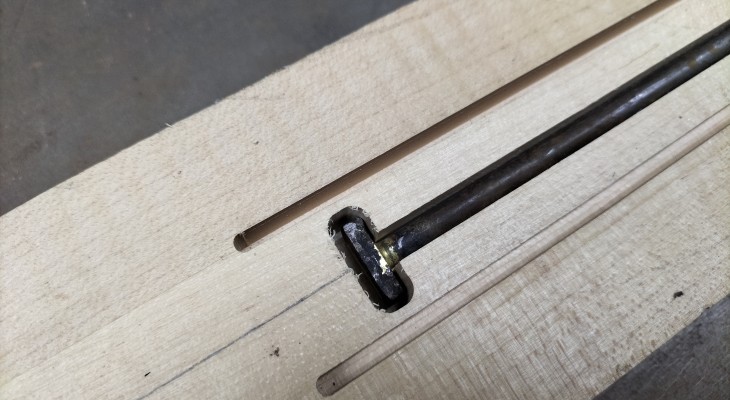
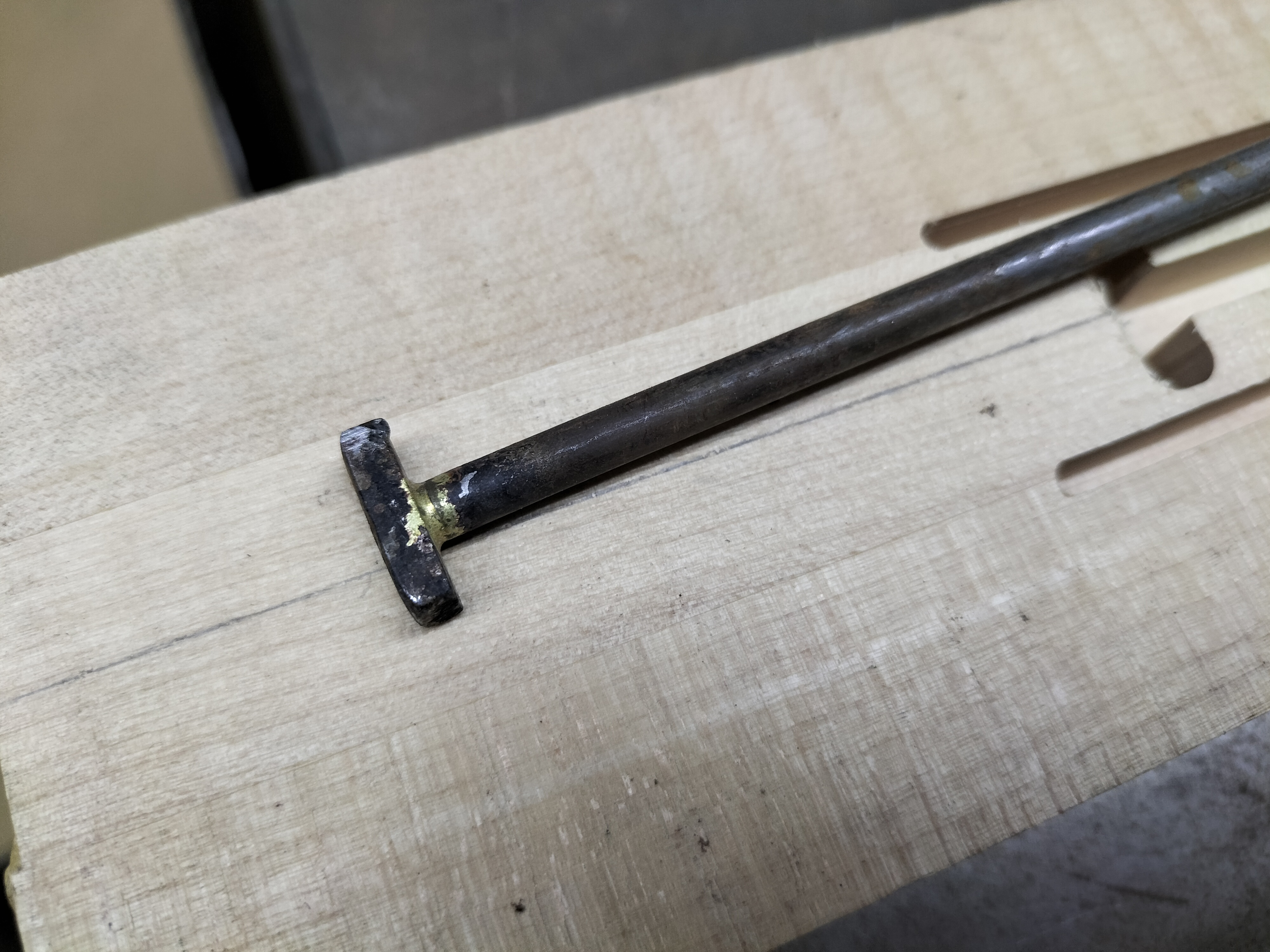
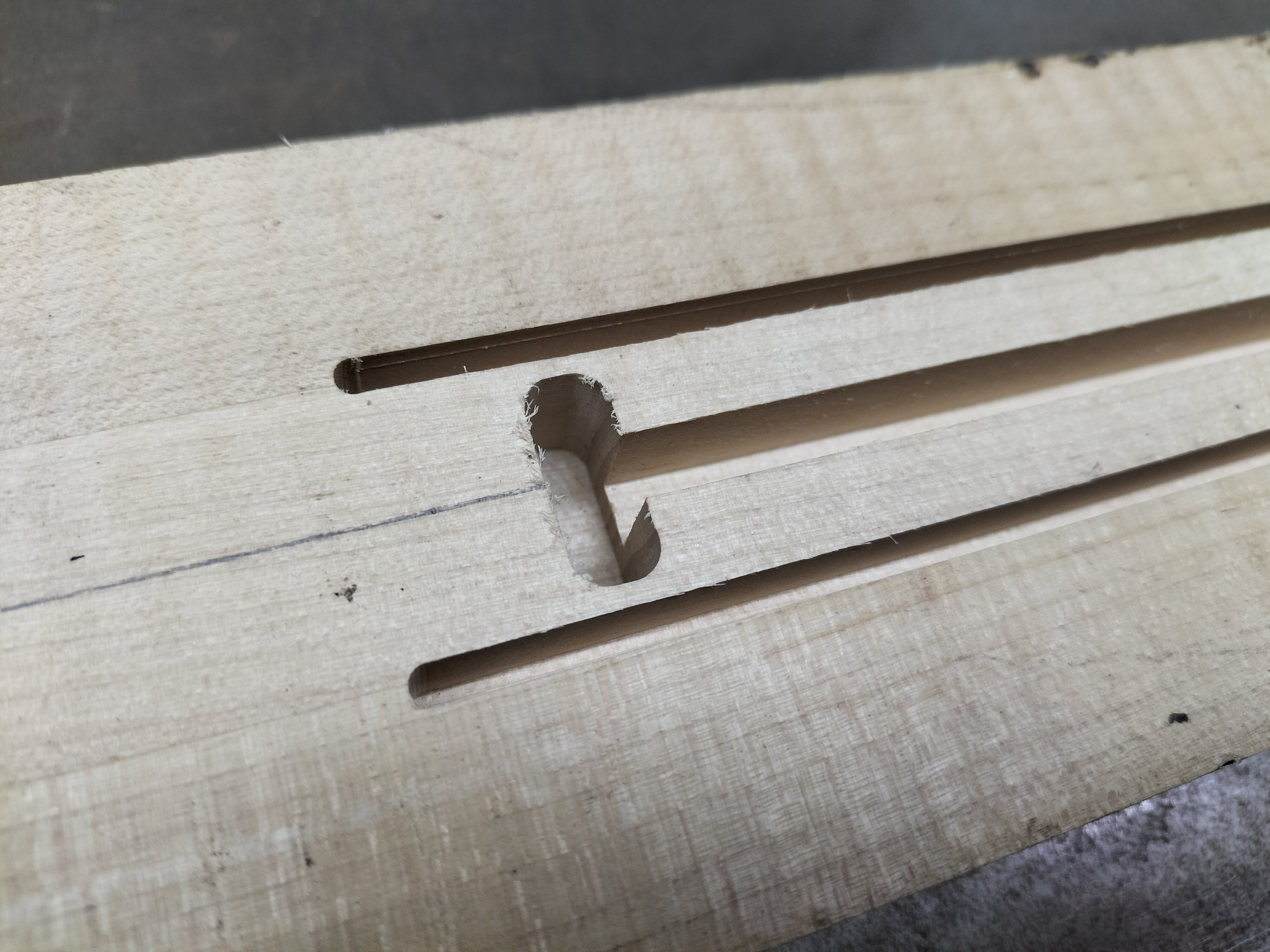
The truss rod is a very simple mechanism: a bent steel rod is simply placed inside the wood.
The image is adapted from a Google search.
The 1-way truss rod has a bent steel rod, while the 2-way truss rod does not need to be bent, so a straight groove is simply dug and installed.
When the nut on the truss rod is turned, the bent rod is pulled up and generates a force inside the truss rod to straighten it.
This force causes the neck to deform in a reverse warp direction.
However, when the rod is straightened, it can no longer generate the force to push up the neck, so it can no longer be warped backwards.
In the case of a 2-way, the two truss rods move either up or down, respectively, to accommodate forward or reverse warping.
~ Can the truss rod force really balance the string tension in the first place? ~This is a very important question.
As a point of reference, the area where the truss rod has the strongest reverse warping force is “where the amount of deflection is greatest.
This is easy for anyone to understand. The point where the truss rod is most effective depends on the position of the truss rod, the length of the truss rod itself, and the amount of deflection, but generally it is in the middle of the neck.
Most music shops and repairmen stop their knowledge at this point, and the word “balanced” may sound right if they are referring only to the point where the truss rod works best, but if you consider the entire neck, it doesn’t work that way.
If you look at the neck as a whole, the forces are actually as follows.
The force of reverse warping decreases from the middle, where the truss rod is most effective, to the ends.
This is because the amount of deflection of the truss rod decreases.
This is because “more deflection = greater range of movement of the truss rod,” and this range decreases as you move toward the ends.
An easy example of where it is not good to “leave it taut” is in the “high rise” situation.
The high incidence of bending occurs at the heel of the neck, where there is little or no force applied to reverse the truss rod.
This is because the part where the neck is screwed on is almost square and strong, while the part where the neck is held by the hand is suddenly cut away by the neck grip and its shape changes, causing an extreme reduction in strength and making it the weakest part of the neck.
In fact, the neck warp does not bend cleanly. It bends and deforms starting from the weak point.
This “bending at the weak point” is the key point, so please keep this in mind.
If the neck is not specially manufactured (without reinforcement or using high-strength wood), this action will work in the neck.
This is a phenomenon that occurs when the neck is not strong enough to support the strings, but it is always present if the strings are left taut, and there is no excuse for warping due to moisture and dryness.
This is something that any repairman will understand.
Repairmen who say, “Just leave the tension on,” wonder why they ignore the high tension. Or, why do they ignore the fact that the weakest part of the neck can warp? I wonder why he is ignoring the high rise and why he is ignoring the warping of weak points in the neck.
They are in the business of giving people wrong information so that they will break their own products and spend money on repairs and replacements.
ESP and other makers have reinforcing material inside the neck, and also have additional guarantee material on the high position side to prevent high tension.
It is a matter of course, but since string tension is that strong, it is “natural” to take countermeasures.
It would be strange if there were no countermeasures.
Many manufacturers are skipping the obvious, and if they are not doing so, the buyer must be aware that he or she is buying something that will deteriorate with continued use.
The customer who buys the product cannot be the victim.
Reinforcing wood literally means reinforcement, but this has a different meaning.
As the old saying goes, wood is not uniform in strength from one end to the other.
In other words, there are soft and hard areas in the neck, and when string tension is applied to these areas, the wood will not warp nicely, but will ripple.
This is because, as I wanted you to remember above, “the weakest point is the point of bending.
Unless the wood is strong and stable, most of the necks will be wavy to be exact.
In order to correct this strength imbalance, artificial reinforcement is placed inside the neck, which adjusts the strength variation of the entire neck, allowing the neck to bend beautifully and the truss rod to work beautifully.
This benefit is most noticeable when making adjustments, and since the neck warp can be straightened out beautifully, it is easier to bring the instrument to a state where it is easy to play without being scared, even if the string height is low.
The common complaints such as “this instrument has a lot of vibrations even though the string height should be the same” are largely due to the accuracy of the straightness of the neck.
It is difficult to achieve a good adjustment unless the neck itself is strong or the entire neck is physically reinforced like ESP’s and the warp is well balanced.
The “weak” and “strong” values are given appropriately, but there may be a neck with a strength balance like this.
This may sound extreme, but as an example, when the string tension is generated and the truss rod is applied to some extent, if we explain from the head side, the string tension in the low position warps the strings forward and the string height around the 1st and 2nd frets becomes high (feels like the nut height is high), and the truss rod is applied most effectively. The low position side near the middle is not strong enough, so the reverse warping is greater only in this area, and the joint area is weak, so it is high up, etc.
This is just an extreme example, but since wood has variations in strength, similar factors are bound to occur even if not as extreme as this.
In other words, the wood must be processed to adjust for this strength variation (reinforcement as described above) to maintain constant strength, or the entire neck must be subjected to the strong force of the truss rod.
It is impossible, but only as an example, for the truss rod force to truly balance the neck, it is impossible unless the truss rod force is equally applied to the entire neck, which is the strongest force that will have the greatest effect.
To begin with, it is impossible to generate this phenomenon with the normal truss rod force alone.
If this force can be generated throughout the entire neck, then it will be possible to balance the variations in the strength of the wood and the weak areas to some extent, if the truss rod force can offset them and generate a repulsive force throughout the neck that will not be defeated by the string tension without any bias.
To be more precise, the force of the truss rod should work on the weak areas and not on the strong areas, but this is impossible.
I don’t know the name of this toy, but can you give me an example of an ideal truss rod?
To be precise, you need a truss rod that has a structure that generates a strong overall force in the middle of the truss rod as mentioned above, and a truss rod that has many places to generate that strong force and many nuts to adjust it is ideal.
If you really want to balance a truss rod, you need a truss rod mechanism that allows you to adjust only the warped part at your will and straighten out the whole truss rod.
Well, that would be impossible. When you get to this point, you can finally say that the string tension is balanced by the truss rod’s force.
To put it simply, the truss rod works only in the middle of the neck, and the rest of the neck is only deformed by the force of the truss rod.
When the strength of the wood is added to these areas, the weak areas have a high deformation rate and the hard areas have a low deformation rate, which can cause problems when straightening the wood (the cause of rippling).
It is impossible to balance the tension of the strings with the force of the truss rod used in the current instruments alone, and in order to come close to balancing it, we should at least try to use artificial materials instead of wood, which has unstable strength, or reinforce the entire instrument to adjust the strength variation, or use a new truss rod that allows the force of the truss rod, which is mentioned above, to be applied to the entire neck. Or use a new truss rod that allows fine adjustment of the truss rod force to the entire neck as mentioned above? The answer to this question will be “yes.
As you can see, the basic importance is the strength of the neck itself, and unless a truss rod adjustment system with a high degree of freedom for the entire neck is added to it, it is impossible to say that the neck is in balance.
In fact, it is better to think that “it just looks balanced right now.
As I have said many times before, if it were really okay, there would be almost no instruments in bad condition in the world.
As I have been saying for a long time, the most important thing is the strength of the neck itself.
Even though I have explained everything so carefully, there will always be people who will come out later and say, “My instrument doesn’t warp,” but I don’t know your instrument.
If you have left your instrument stretched for many years and it has not deteriorated, you either happen to have a good, strong, stable piece of wood, or you are an amateur who does not notice that the condition of the instrument has deteriorated.
I am talking about the present. I don’t know what it was like in the past.
It is just old people who are not in the industry saying such things.
All instruments are not in the same condition or state. Don’t you think or try to understand that level?
It’s like saying, “Shohei Ohtani is a professional baseball player, so you can do it too, right? It is like saying, “Shohei Otani can play professionally, so you can too.
The current repair scene is a miserable one, where I have to tell customers that their expensive, famous instruments that they bought new have warped so much that there is little room for the truss rod to be adjusted, and that there seems to be no way for them to last much longer.
The shocked look on the customer’s face is nothing but stress.
If a music shop had inspected the instrument, they would have returned it to the manufacturer, wouldn’t they? I’m like, “No, I didn’t inspect the product.
In fact, they don’t inspect their products, and since they are all black-owned companies with no proper staff, you can’t tell if a product is in good or bad condition. If you are going to buy from a place like this, you have to be able to question everything and check everything with your own eyes before you make a purchase.