「弦は張りっぱなしで良い」というウソ。「ネック反りはトラスロッドの力でバランスしている」というウソ。
- 2025/03/08
- Category:
今現在でも論争が起こっている「弦は緩めるべき?弦は張りっぱなしで良い?」という話。
いつまで続けるのか分かりませんがこの様に答えがハッキリとしない物事はいくらでも言えて誤魔化す事ができ、それにおいて人を騙すビジネスモデルが入ってきますのであくどいです。
結局は情報弱者が騙されるので、勉強して自己防衛するしか方法はありません。
日本は特にメディア洗脳が強く、誰が何と言おうと有名な人や大きな企業が言えばそれが正しいと鵜呑みにします。
ハッキリ言えばアホばかりなので、そこが治らない限り悪い企業は無くならないでしょう。
何かがあれば人のせい、自分の責任を他人に押し付け一向に成長しないその姿勢を直した方が良いです。
全てにおいて悪いのは国民、勉強しおかしい事を見抜く力を持つ事とおかしな事には従わない姿勢を持たないといけません。
それが皆が行動に起こせていたら、悪い企業も存続できず滅んでいきます。そして本当に良い企業だけが残る社会になります。~そもそも答えは既に出ている~

昔から発信しておりますがリペアショップで起きている事実を全ての楽器に関わる所が公表すべきです。
恐らく私だけじゃないでしょうか?
その理由も簡単で、商売の取引先の都合が悪い事は言えないので多くのリペアショップもダンマリを決め込みます。
また今まで自分達が無知な発言を長く続けていた事もあり、今更「間違っていました」と言えないからです。私から発信せずとも、80年代頃にモジュラスが出てきてカーボンネックが採用された際に答えは出ています。
木材よりも硬質で人工物により湿気乾燥への安定性も抜群、モジュラスが出てきた際にカーボンネックは反らないとされて最初はトラスロッドも入れられていませんでしたが、結果反るのでトラスロッドが入れられました。
これが既に答えです。それだけ弦張力が強く、ネックがその力に耐えきれる構造で無いから弦張力に負けて曲がっていきます。
弦は緩めないといけないし、その理由は楽器が物理的に耐えられる負荷の範囲を超えているから。
弦張力という大きな負荷に長年耐えられない構造だからという事と多くの楽器を見てきて状態が悪い楽器が多いからです。弦を張りっぱなしで良いとするなら状態が悪い楽器は殆ど出てこない、しかし世の中の大半は状態が悪い。
それを扱う現場であれば猶更分かる話、知ってて言わないのか知ってても理解できない素人かの二択でしかありません。弦を緩めるかどうか?の話は過去のブログ記事やYoutubeに散々上げていますので詳しくはそちらをご覧下さい。
さすがに過去にした同じ話をここでするのも面倒なのでご自身で勉強する事、結論だけ表記しますが緩めるかどうかの判断はまず自分の楽器を「正しく調整できた状態」にした上でトラスロッドを回して「ロッドの余り量を確認」して下さい。
この余り量が多い・100%に近いなら逆反りしてしまうと困る事になる(1Wayトラスロッドの場合)ので弦は張りっぱなしで良いと言えますがこの様な状態が良い楽器は珍しいです。
殆どの楽器はトラスロッドが結構効いている・ユルユルよりも限界への方が近い状態が大半です。
この余り量を見て緩める量を調整して下さい。
これら作業で実際に余り量を確認をした上で張りっぱなしで良いとか緩めないといけないと言えないならダメです。
これら作業を多くの楽器に行えば、トラスロッドが100%近く余っている楽器なんて殆ど目にしないので割合としては「弦は緩めた方が良い」の方が圧倒的に高いです。※木材に関係する物の保管は基本、乾燥しない様に湿度を基本的に一定以上をキープする事は前提。
~例~
・トラスロッド限界 → 弦を張力が発生しないダルダルに緩め、トラスロッドの力で逆反りしてくれたらラッキーな状態にする。
・トラスロッドの余り量が半分程度 → 1音半下げ~2音半下げ位にしておく。この時に余り量を増やしたいなら上記の様にダルダルにして逆反りしたらラッキー、余り量が増えた際に半音~1音下げ等で保管する等で応用する。
・トラスロッドが100%余り量がある → 逆反りすると困るので弦を張りっぱなしにしておき、むしろ順反りしてきてから緩めて保管する。(楽器として理想的な状態だが、実際には殆ど無い状態)
~何故私がトラスロッドの余り量にうるさいのか?~

トラスロッドの余り量は非常に重要で、その理由は「寿命」に直結するからです。
楽器は基本的に「一生もの」にできます。
それができない理由として「順反りが酷いから」になってきます。
トラスロッドの余り量があれば順反りを直し通常通り使用できますがこのトラスロッドが効く範囲は「有限」です。無限に使える訳ではありません。
つまり一生使い続けるにはどれだけ「ネックを順反りさせないか?」が非常に重要になります。
当たり前ですが「トラスロッドを交換すれば良いのでは?」というバカな質問はしないで下さい。トラスロッドが余っていて順反りさえしなければ楽器は一生使い続けられます。
ナットやフレット等の消耗品は交換すれば良いし、各所の調整機構はどうとでも調整できますがトラスロッド調整だけは有限なので順反りさせない事が楽器としてのそのまま寿命という事です。
「トラスロッドの余り量=寿命」です。その重要なトラスロッドの余り量が近年は木材が柔らかい事から「新品でトラスロッドの余り量が少ない・限界で売っている」という事がいかにマズイ事か理解できますか?
つまり高額な商品でも長持ちしない状態、最初からこんなに状態悪いので将来長年使い続けられる訳ない状態で売っているという事です。
だから買う際にしっかり状態を確認させてから買わないといけません。
もちろん新品はこの先どうなるか未来の事は分かりませんが、初期状態を見るに将来性が無い予想は付くでしょう。
スタート地点で状態が悪いなら、この先長年生き残れる訳ないです。中古品が何故買う際に良いのか、例えば2000年製の楽器が現在2025年に購入した際、トラスロッドの余り量が多い場合は25年もこの良い状態をキープし生き残った良質個体と判断でき、そうした個体はこの先も状態が変わらず使い続けられるだろうという目途が立つからです。
でもこうした情報は私が昔から発信している訳ですし、ハッキリ言えば常識です。
買った楽器が状態悪い等で被害に会っても文句が言えるのか微妙な範囲と思います。
新品でも状態を細かく公表していない楽器屋を疑いもせず信用している客が悪いです。だから客側がお店に対し「状態の詳しい表記をしろ!」と本来は怒らないといけません。
それをやらないんだから、現状を変えようとしないし行動もしないから今の様な社会になっています。基本的にお店は新品でもトラスロッドの余り量を表記させる様に提示する事と、過去にもYoutubeにアップした内容の様に1本1本検品した動画を公表する必要があります。
~大事な事は木材強度~

「弦は張りっぱなしで良い」というアホの意見に多いのは「トラスロッドの力で反りがバランスしているから」という理屈なのですが、完全におかしな話です。
例えば上記のモジュラスはトラスロッドが入っていないモデルが存在しているし、現行品でもトラスロッドを入れていないメーカー「ヴィジェ」がある訳と昔のモデルを再現したアコギ(マーチン等)にもトラスロッドが入っていないモデルが存在します。
これらはどう説明するのか話を聞きたいです。大事な事はトラスロッドの力ではなく木材自体の「強度」が大事です。
弦張力に耐えきれるその強度が無いから反る訳で、極端に言えば木材で作るなら握れない位に非常に太いネックにすれば弦は張りっぱなしで反りません。理由は弦張力に負けない位の強度をネックが持っているから。
その強度を持っていないから反る、簡単な話です。
この強度が非常に高い状態でも反るなら湿気や乾燥・シーズニング不足が原因になってきます。そもそもチューニングしていけば分かる話ですが、ギターの場合6弦から1弦にチューニングし1弦が終えた際に6弦に戻れば半音以上は下がっているでしょう。
この理由はネックが弦張力に負けて順反りして先にチューニングした6弦が緩むからです。
弦張力にネックが負けている事もこれで分かるでしょう。~トラスロッドの詳細~
今回のポイントです。
「トラスロッドの力でバランスする」という、トラスロッドの力はそんなに万能的で都合が良い機能なのでしょうか?答えはNoです。
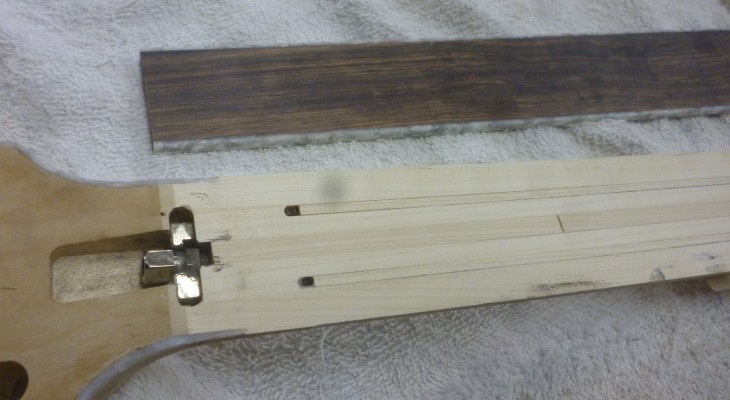
トラスロッドは非常に単純な機構で、曲げた鉄の棒を木材内に仕込んでいるだけです。

画像はGoogle検索で出てきた物を流用しています。
1Wayトラスロッドは曲げた鉄の棒を仕込んでおり、2Wayは曲げて仕込む必要が無いので真っ直ぐな溝を掘って仕込むだけです。
今回は分かり易く1Wayトラスロッドで説明しますが、トラスロッドのナットを回していくと曲がった棒が引っ張られ真っ直ぐになろうとする力を内部に発生させます。
この押し上げる力によりネックを逆反り方向に変形させていきます。しかしこの棒が真っ直ぐになると押し上げる力を発生できなくなるので逆反りさせる事ができず、この状態と「トラスロッド限界」と表します。
2Wayも同様の動きです。2Wayの場合は2本のトラスロッドがそれぞれ上か下かに動いて順反り・逆反りに対応します。
~そもそもトラスロッドの力で弦張力と本当にバランスできるのか?~

ポイントとして、トラスロッドが逆反りさせる力が一番強い部分は「たわみ量が一番多い所」です。
これは誰でも簡単に分かる事でしょう。トラスロッドが仕込まれる位置やトラスロッド自体の長さ・たわみ量により最も効くポイントは各メーカーで異なりますが大体はネックの真ん中辺りです。大体の楽器屋やリペアマンはココの時点で知識が止まっている人が多く、バランスしているという言葉はこの「トラスロッドが一番効くポイントだけ」を言ってるなら正しく聴こえる言葉に感じてしまいますが、ネック全体で考えるなら実際はそう上手くいきません。
ネック全体で見ると実際は以下の様な力になります。

トラスロッドが最も効く真ん中から端に向かい逆反りさせる力は弱まっていきます。
何故ならトラスロッドのたわみ量が少なくなるからです。「たわみ量が多い=トラスロッドが移動する範囲が大きい」からで、その範囲が端に行くにつれ減っていきます。
「張りっぱなしで良い」のが良くない例として分かり易いのが「ハイ起き」です。

トラスロッドの逆反りさせる力が殆ど掛からない・力が無いに等しいネックのヒール部分から折れ曲がる現象がハイ起きです。
これはネックをネジ止めする箇所は殆ど真四角で強度が高いに対し、手で握る箇所になるといきなりネックグリップに形状が削られて形が変化する事から極端な強度低下が起きてしまいネックでも弱い部分になります。
実際にネック反りは綺麗には曲がりません。弱い所を起点に曲がって変形します。
この「弱い所を起点に曲がる」がポイントですので絶対に覚えていて下さい。
特別な製造加工(補強する事や強度が高い木材を使用しない場合)をしない通常の仕様ならネック内でこの作用が働きます。ハイ起きは強度が充分に無いネックであればその曲がり具合の大小はあるが弦を張りっぱなしにしていれば必ずと言っても良い位に起こる現象でありこの現象は湿気乾燥で反る言い訳も通用しない部分になります。
この辺りはリペアマンなら誰でも分かる話でしょう。
「張りっぱなしで良い」というリペアマンはハイ起きを何で度外視してるのだろう?と思う事やネック内の強度が弱い所が反る事も何で度外視してるのだろう?と思ってしまいます。
間違った情報を与え、自分で壊させて修理や買い替えでお金を使ってもらうビジネスをしているからです。
ESP等のメーカーはネック内部に補強材を仕込んでいたり、更にハイポジション側にはハイ起き防止用として追加で保証材を仕込んでいます。
当たり前の話ですが弦張力はそれだけ強いので対策する事はハッキリ言えば「当たり前」です。
対策していない方がおかしいです。
多くのメーカーがその当たり前をサボっている訳で、それをしていないメーカー品なら買う側も使い続けて状態が悪くなる物を買ってる意識を持たないといけません。
買う客が被害者面はできないです。補強材は文字通り補強の意味ですがこれはまた違う意味があります。
木材は昔から言っている通りで「端から端まで均一な強度ではない」事です。
つまりネック内にも柔らかい所・硬い所が存在し、そこに弦張力が加わると綺麗に反らず波打ちします。
上記でも覚えていてほしかった「弱い所を起点に曲がる」からです。
強度が高く安定した木材で無い限りはネックの殆どは正確には波打ちします。この強度のバランスの悪さを整える為、人工物の補強材を内部に仕込む事でネック全体の強度バラつきを整えてネック反りが綺麗に曲がる事やトラスロッドの効き具合も綺麗に反る様になります。
この恩恵は調整時に顕著になって現れ、ネック反りが綺麗に真っ直ぐにできるので弦高が低くてもビビらないし弾き易い状態に持って行きやすくなります。
よくある「同じ弦高のはずなのにこの楽器はビビりが多い」等はこのストレート精度による影響も大きいです。
ネック自体の強度が高いか、ESPの様にネック全体を物理的に補強し反りが綺麗に整えられるバランス性を持っているネックでないと良い調整状態に持っていくのは難しいです。
「弱」や「強」は適当に付けてますが、この様な強度バランスもネックもある事でしょう。
極端な話にはなるかもしれませんがあくまで例題として上記の状態で弦張力が発生しある程度トラスロッドを効かせている場合、ヘッド側から説明するとローポジションが弦張力で順反りし1~2フレット付近の弦高が高くなる(ナット高が高い様な弾き心地)、トラスロッドが最も効く真ん中付近のローポジション側の強度が弱い為にこの部分だけ逆反り具合が大きくなる、ジョイント付近が弱いのでハイ起き気味になる、等。
これはあくまで極端な例ですが木材は強度のバラつきが出てきますので、この様な極端な例でなくても似た様な要素は必ず発生します。
つまりこの強度バラつきを整える加工(上記の様な補強材)を行って強度を一定に保てる様にしてあるか、ネック全体にトラスロッドの強い力を発生させないといけません。

無理な話ではありますがあくまで例として、トラスロッドの力で本当にバランスさせるにはトラスロッドの力が最も効く強い力をネック全体に均等に掛かってないと無理です。
そもそも通常のトラスロッドの力だけでこの現象を発生させるのは無理です。この力が全体に発生できれば木材の強度バラつきもある程度弱い所もトラスロッドの力で相殺させ、ネック全体に偏りなく弦張力に負けない反発力を発生させていたらバランスできる事になるでしょう。
もっと細かく言うなら強度が弱い所にはトラスロッドの力が効いて強度が強い所には効かない様な力が必要ですが、そんな事は無理です。
このおもちゃ、名前が分からないのですが理想的なトラスロッドの例えとして伝わりますか?
正確には上記にもあるトラスロッドの真ん中辺りの強い力を全体的に発生させる構造をしたトラスロッドとなる物が必要で、その強い力を発生させる箇所が多いトラスロッド、その調整するナットが沢山あるトラスロッドが理想的です。
グリップ側に調整するナットが複数出てて、本気でバランスさせるなら反ってる箇所だけを自分の意思で調整でき全体を綺麗に真っ直ぐに調整していくトラスロッド機構が必要です。
まぁ無理な話でしょう。ここまできてやっと「トラスロッドの力で弦張力がバランスしてる」と言える領域になります。分かり易く言うならトラスロッドが効く所はネックの真ん中辺りだけで、他はその力に影響されて変形しているに過ぎません。
ここの木材の強度が加わると弱い所は変形率が大きく硬い所は変形率が低いから綺麗に真っ直ぐにする際に支障が出てくる(波打ちの原因)となります。今楽器に使用されているトラスロッドだけの力で弦張力とバランスさせるには不可能で、バランスさせる事に近付ける為にはせめてもの工夫として強度が不安定な木材でなく人工物を使うか、全体的な補強をして強度のバラつきを整えるか、上記にもあるトラスロッドの力がネック全体に細かく調整できる新たなトラスロッドを使用するか?になる事でしょう。
これで分かると思いますが基本的に大事な事はネック自体の強度が基本、そこにネック全体への自由度が高いトラスロッド調整システムが加わらないとバランスしてると言うのは不可能です。
実際は「今はバランスしている様に見えるだけ」と思った方が良いです。
何度も言いますが本当に大丈夫なら状態が悪い楽器は世の中に殆ど存在しなくなります。
大事な事も昔から言っていますが「ネック自体の強度」が重要です。ここまで丁寧に説明しても後で必ず出てくる「私の楽器は反らない」とか言う人が出てきますが、あなたの楽器なんて知りません。
長年張りっぱなしにして状態が悪くならないならそうした強度が高く材の安定した良い個体をたまたま手にしているか、状態が悪くなっている事も気が付かない素人なだけです。
私は今現在の話をしています。昔がどうとか知りません。
そんな事を業界の人でもない人が言ってくるのはただの老害です。
楽器は全て条件や状態が同じではありません。その程度も考えないし理解しようとしないのでしょうか?
プロ野球の大谷翔平選手がプロで活躍できるんだからお前もできるだろ?って言ってる様なものです。現在のリペア現場は悲惨な物で新品で買った高額で有名な楽器が大きく順反りし調整でトラスロッドの余裕が少ない・限界になったのでこれから長持ちする目途が無さそうですね、と伝える日々です。
ショックを受けるお客様の顔はストレスでしかありません。
そもそも楽器屋で検品してたらメーカーに返品してるだろ?って状態です。
実際は検品なんてしてませんしブラック企業ばかりでまともな人員も居ませんから状態が良いとか悪いとかの判断も分からないですし、こうした所から買い物するなら全て疑って掛かり自分の目で全てを確認できないと買うに値できません。読んで頂きありがとうございました♪
The controversy still rages to this day, “Should I loosen the strings? Should I leave the strings taut?” I don’t know how long it will continue.
I don’t know how long it will continue, but things like this, where the answer is not clear, can be said and deceived as much as possible, and the business model of deceiving people comes in.
In the end, it is the people with weak information who are deceived, so the only way to protect yourself is to study and defend yourself.
In Japan, the media brainwashing is particularly strong, and people take for granted that whatever a famous person or a big company says is right, no matter who says it.
To put it bluntly, we are all idiots, and until that is cured, bad companies will not disappear.
It is better to fix their attitude of blaming others when something happens, putting the blame on others and never growing up.
The people are to blame for everything. They need to study and have the ability to recognize what is wrong and have an attitude of not following what is wrong.
If everyone could act on this, bad companies would not survive and would perish. And only the truly good companies will remain in our society.~The answer is already out there.
As I have been saying for a long time, all the places involved in musical instruments should disclose the facts about what is happening in repair stores.
Perhaps I am the only one.
The reason for this is simple: many repair stores are not willing to say what is inconvenient for their business partners, so they keep quiet.
Also, because they have been making ignorant statements for a long time and cannot say “I was wrong” now.The answer came out around the 80’s when modulus was introduced and carbon necks were adopted.
Carbon necks are harder than wood and have excellent stability against moisture and drying due to man-made materials. When modulus came out, it was assumed that carbon necks would not warp, and no truss rod was put in at first, but as a result, a truss rod was put in.
This is already the answer.The tension of the strings is so strong that the neck is not structured to withstand the force, so the neck bends under the tension of the strings.
The strings must be loosened, and the reason for this is that the instrument is physically beyond the range of load it can withstand.
This is because the structure cannot withstand the great load of string tension for many years, and also because I have seen many instruments in poor condition.If it were okay to leave the strings in place, there would be few instruments in bad condition, but the majority of the world’s instruments are in bad condition.
If you are in the field dealing with such instruments, you will understand this story even more, and there are only two choices: either you know it and don’t say it, or you know it but are an amateur who doesn’t understand it.Loosening the strings or not? I have talked about this in past blog posts and on Youtube, so please refer to those for more details.
It would be tedious to repeat the same story I have told in the past here, so you should study it by yourself.
If the amount of excess is large or close to 100%, you can say that the strings should be left taut because you will be in trouble if they warp backwards (in the case of a 1-way truss rod), but it is rare to find an instrument in such a good condition.
Most instruments have a truss rod that is closer to the limit of its tension than it is to the limit of its looseness.
Adjust the amount of loosening by looking at the amount of excess.
If you cannot say that the truss rod should be left taut or loosened after checking the amount of excess in these operations, it is no good.
If you do this for many instruments, you will not see instruments with truss rods with nearly 100% excess, so the percentage of “strings should be loosened” is much higher.The basic premise for storing items related to wood is to keep the humidity above a certain level to prevent them from drying out.
~Example
Truss rod limit → Loosen the strings to a dull dull state where no tension is generated, and you will be lucky if the truss rod warps the strings backwards.
If you want to increase the amount of truss-rod excess, you should lower it by 1 1/2 to 2 1/2 notes. If you want to increase the amount of excess at this time, you should make the truss rod as dull as above and be lucky if it warps backwards, or you can keep it half to one note lower when the amount of excess increases.
If you want to increase the amount of excess in this case, you are lucky if it is inverted, but if you want to increase the amount of excess in this case, you should keep the strings taut. (ideal condition for an instrument, but in reality there is very little)
~ Why am I so picky about the amount of extra truss rod? ~ Why am I so picky about the amount of truss rod excess?
The amount of truss rod left over is very important because it directly affects the “life” of the instrument.
Basically, an instrument can be made to last a lifetime.
The reason why this is not possible is because of severe forward warping.
If there is an excess amount of truss rod, the warp can be corrected and the instrument can be used as usual, but the range in which this truss rod can be used is “finite. It does not mean that it can be used indefinitely.
In other words, if you want to use the instrument for a lifetime, it is very important to keep the neck from warping. It is very important to keep the neck from warping.
Of course, you may be asking yourself, “Can’t I just replace the truss rod? Do not ask the silly question, “Can’t I just replace the truss rod?As long as the truss rod is left over and the neck is not warped, the instrument can be used for a lifetime.
You can replace nuts, frets, and other consumables, and you can adjust the adjustment mechanism in any way you like, but truss rod adjustment is finite, and the life of the instrument is to keep the truss rod from bowing out.
The amount of truss rod left over = the life of the instrument.Do you understand how bad it is to sell a new instrument with a small amount of truss rod left over or at the limit of the amount of truss rod left over because the wood has become soft in recent years?
In other words, even expensive products are sold in a condition where they will not last long and cannot be used for many years in the future because they are in such a bad condition from the beginning.
That is why you have to make sure that you check the condition of the product before you buy it.
Of course, we don’t know what the future holds for new products, but we can predict that they will not have a future by looking at their initial condition.
For example, if you buy a 2000 instrument in 2025 and it has a lot of truss rod left over, you can be sure that the instrument has survived 25 years in good condition and will continue to be used for 25 years.But I have been giving this information for a long time, and it is common sense to say the least.
I think it is a delicate range to complain if the instrument you bought is in poor condition or otherwise damaged.
It is the customer’s fault for trusting a music shop that does not disclose the condition of the instrument, even if it is a new one, without questioning it.Therefore, the customer should be angry at the store and say, “Make a detailed description of the condition of the instrument! The customer should be angry with the shop.
The reason why our society has become the way it is today is because we don’t do that, we don’t try to change the current situation, and we don’t take action.~ The important thing is wood strength~.
Many idiots who say that “strings should be left taut” reason that “the force of the truss rod balances out the warping,” but this is completely ludicrous.
For example, the modulus mentioned above has a model without a truss rod, and there is a reason why there is a manufacturer “Vigier” that does not have a truss rod in their current products, and there are also acoustic guitars (Martin, etc.) that reproduce old models that do not have a truss rod.
I would like to hear how you explain these.The important thing is not the strength of the truss rod, but the “strength” of the wood itself.
If you take it to the extreme and make the neck so thick that it cannot be gripped, the strings will remain taut and the neck will not warp. The reason is that the neck has enough strength to withstand the tension of the strings.
If the neck does not have that strength, it will warp.
If it warps even when this strength is very high, then moisture, dryness, or lack of seasoning is the cause.In the case of a guitar, if you tune from the 6th string to the 1st string, and when you return to the 6th string at the end of the 1st string, it will have dropped at least half a note.
The reason for this is that the neck is losing tension on the strings and the neck is bowing forward, loosening the sixth string that was tuned first.
You can also see that the neck is losing tension on the strings.~Truss rod details~.
The point of this issue.
Is the power of the truss rod, “balanced by the power of the truss rod,” such a versatile and convenient function? The answer is no.
The truss rod is a very simple mechanism: a bent steel rod is simply placed inside the wood.
The image is adapted from a Google search.
The 1-way truss rod has a bent steel rod, while the 2-way truss rod does not need to be bent, so a straight groove is simply dug and installed.
When the nut on the truss rod is turned, the bent rod is pulled up and generates a force inside the truss rod to straighten it.
This force causes the neck to deform in a reverse warp direction.However, when the rod is straightened, it can no longer generate the force to push up the neck, so it can no longer be warped backwards.
In the case of a 2-way, the two truss rods move either up or down, respectively, to accommodate forward or reverse warping.
~ Can the truss rod force really balance the string tension in the first place? ~This is a very important question.
As a point of reference, the area where the truss rod has the strongest reverse warping force is “where the amount of deflection is greatest.
This is easy for anyone to understand. The point where the truss rod is most effective depends on the position of the truss rod, the length of the truss rod itself, and the amount of deflection, but generally it is in the middle of the neck.Most music shops and repairmen stop their knowledge at this point, and the word “balanced” may sound right if they are referring only to the point where the truss rod works best, but if you consider the entire neck, it doesn’t work that way.
If you look at the neck as a whole, the forces are actually as follows.
The force of reverse warping decreases from the middle, where the truss rod is most effective, to the ends.
This is because the amount of deflection of the truss rod decreases.This is because “more deflection = greater range of movement of the truss rod,” and this range decreases as you move toward the ends.
An easy example of where it is not good to “leave it taut” is in the “high rise” situation.
The high incidence of bending occurs at the heel of the neck, where there is little or no force applied to reverse the truss rod.
This is because the part where the neck is screwed on is almost square and strong, while the part where the neck is held by the hand is suddenly cut away by the neck grip and its shape changes, causing an extreme reduction in strength and making it the weakest part of the neck.
In fact, the neck warp does not bend cleanly. It bends and deforms starting from the weak point.
This “bending at the weak point” is the key point, so please keep this in mind.
If the neck is not specially manufactured (without reinforcement or using high-strength wood), this action will work in the neck.This is a phenomenon that occurs when the neck is not strong enough to support the strings, but it is always present if the strings are left taut, and there is no excuse for warping due to moisture and dryness.
This is something that any repairman will understand.
Repairmen who say, “Just leave the tension on,” wonder why they ignore the high tension. Or, why do they ignore the fact that the weakest part of the neck can warp? I wonder why he is ignoring the high rise and why he is ignoring the warping of weak points in the neck.
They are in the business of giving people wrong information so that they will break their own products and spend money on repairs and replacements.ESP and other makers have reinforcing material inside the neck, and also have additional guarantee material on the high position side to prevent high tension.
It is a matter of course, but since string tension is that strong, it is “natural” to take countermeasures.
It would be strange if there were no countermeasures.
Many manufacturers are skipping the obvious, and if they are not doing so, the buyer must be aware that he or she is buying something that will deteriorate with continued use.
The customer who buys the product cannot be the victim.Reinforcing wood literally means reinforcement, but this has a different meaning.
As the old saying goes, wood is not uniform in strength from one end to the other.
In other words, there are soft and hard areas in the neck, and when string tension is applied to these areas, the wood will not warp nicely, but will ripple.
This is because, as I wanted you to remember above, “the weakest point is the point of bending.
Unless the wood is strong and stable, most of the necks will be wavy to be exact.In order to correct this strength imbalance, artificial reinforcement is placed inside the neck, which adjusts the strength variation of the entire neck, allowing the neck to bend beautifully and the truss rod to work beautifully.
This benefit is most noticeable when making adjustments, and since the neck warp can be straightened out beautifully, it is easier to bring the instrument to a state where it is easy to play without being scared, even if the string height is low.
The common complaints such as “this instrument has a lot of vibrations even though the string height should be the same” are largely due to the accuracy of the straightness of the neck.
It is difficult to achieve a good adjustment unless the neck itself is strong or the entire neck is physically reinforced like ESP’s and the warp is well balanced.The “weak” and “strong” values are given appropriately, but there may be a neck with a strength balance like this.
This may sound extreme, but as an example, when the string tension is generated and the truss rod is applied to some extent, if we explain from the head side, the string tension in the low position warps the strings forward and the string height around the 1st and 2nd frets becomes high (feels like the nut height is high), and the truss rod is applied most effectively. The low position side near the middle is not strong enough, so the reverse warping is greater only in this area, and the joint area is weak, so it is high up, etc.
This is just an extreme example, but since wood has variations in strength, similar factors are bound to occur even if not as extreme as this.
In other words, the wood must be processed to adjust for this strength variation (reinforcement as described above) to maintain constant strength, or the entire neck must be subjected to the strong force of the truss rod.
It is impossible, but only as an example, for the truss rod force to truly balance the neck, it is impossible unless the truss rod force is equally applied to the entire neck, which is the strongest force that will have the greatest effect.
To begin with, it is impossible to generate this phenomenon with the normal truss rod force alone.If this force can be generated throughout the entire neck, then it will be possible to balance the variations in the strength of the wood and the weak areas to some extent, if the truss rod force can offset them and generate a repulsive force throughout the neck that will not be defeated by the string tension without any bias.
To be more precise, the force of the truss rod should work on the weak areas and not on the strong areas, but this is impossible.I don’t know the name of this toy, but can you give me an example of an ideal truss rod?
To be precise, you need a truss rod that has a structure that generates a strong overall force in the middle of the truss rod as mentioned above, and a truss rod that has many places to generate that strong force and many nuts to adjust it is ideal.
If you really want to balance a truss rod, you need a truss rod mechanism that allows you to adjust only the warped part at your will and straighten out the whole truss rod.
Well, that would be impossible. When you get to this point, you can finally say that the string tension is balanced by the truss rod’s force.To put it simply, the truss rod works only in the middle of the neck, and the rest of the neck is only deformed by the force of the truss rod.
When the strength of the wood is added to these areas, the weak areas have a high deformation rate and the hard areas have a low deformation rate, which can cause problems when straightening the wood (the cause of rippling).It is impossible to balance the tension of the strings with the force of the truss rod used in the current instruments alone, and in order to come close to balancing it, we should at least try to use artificial materials instead of wood, which has unstable strength, or reinforce the entire instrument to adjust the strength variation, or use a new truss rod that allows the force of the truss rod, which is mentioned above, to be applied to the entire neck. Or use a new truss rod that allows fine adjustment of the truss rod force to the entire neck as mentioned above? The answer to this question will be “yes.
As you can see, the basic importance is the strength of the neck itself, and unless a truss rod adjustment system with a high degree of freedom for the entire neck is added to it, it is impossible to say that the neck is in balance.
In fact, it is better to think that “it just looks balanced right now.
As I have said many times before, if it were really okay, there would be almost no instruments in bad condition in the world.
As I have been saying for a long time, the most important thing is the strength of the neck itself.Even though I have explained everything so carefully, there will always be people who will come out later and say, “My instrument doesn’t warp,” but I don’t know your instrument.
If you have left your instrument stretched for many years and it has not deteriorated, you either happen to have a good, strong, stable piece of wood, or you are an amateur who does not notice that the condition of the instrument has deteriorated.
I am talking about the present. I don’t know what it was like in the past.
It is just old people who are not in the industry saying such things.
All instruments are not in the same condition or state. Don’t you think or try to understand that level?
It’s like saying, “Shohei Ohtani is a professional baseball player, so you can do it too, right? It is like saying, “Shohei Otani can play professionally, so you can too.The current repair scene is a miserable one, where I have to tell customers that their expensive, famous instruments that they bought new have warped so much that there is little room for the truss rod to be adjusted, and that there seems to be no way for them to last much longer.
The shocked look on the customer’s face is nothing but stress.
If a music shop had inspected the instrument, they would have returned it to the manufacturer, wouldn’t they? I’m like, “No, I didn’t inspect the product.
In fact, they don’t inspect their products, and since they are all black-owned companies with no proper staff, you can’t tell if a product is in good or bad condition. If you are going to buy from a place like this, you have to be able to question everything and check everything with your own eyes before you make a purchase.Thank you for reading.
〒114-0014 東京都北区田端1-21-3 エーデルワイス101
ギターリペア工房 Draw a New Sound
東京都 山手線 田端から徒歩2分 どこよりも早いリペア早期仕上げ対応可能のリーズナブル料金&丁寧な作業のギターリペアショップです♪
●ホームページ Draw a New Sound
●YouTubeではブログでは語られない裏話からギターの作り方まで掲載中!
マイチャンネル YouTubeチャンネル●ツイッター DNS_Guitar