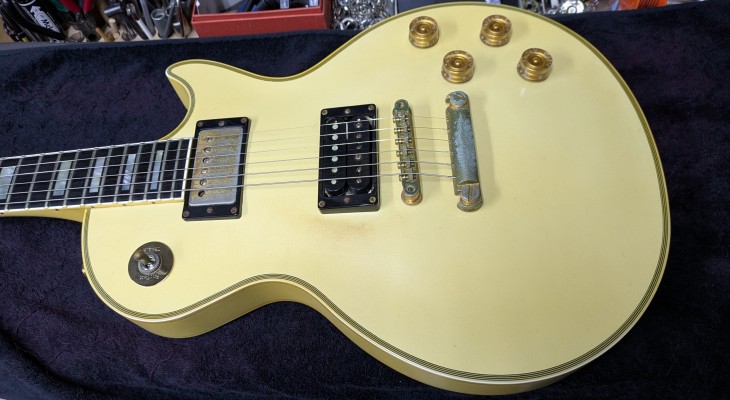
This change produces a clean, crisp sound without excessive front end thickness, avoiding a boomy feel for a more defined tone.
Highly recommended for those troubled by overly thick front end sound.
The customer replaced the pickups and made a wiring mistake.
We will also replace the existing rotary switch with a toggle switch.
The pickups have been replaced with Seymour Duncan Omegas.
The sound is hard and tight, with a clear, well-defined tone. I think it sounds good with distortion.
The saddle screws are rusted and won’t turn, but the string height is set correctly, so it’s usable. However, it’s in a condition where replacement is recommended.
The clean tone is firm. The front pickup has a thick tone without being boomy, and it has good projection for soloing.
The middle pickup has a thick tone but also good projection, making it a manageable and pleasant sound.
The rear pickup has no harshness and is easy on the ears. Overall, it was a pickup with a good impression in terms of sound across all positions.
Wiring repair and setup for a Fender Japan Jazzmaster.
The internal wiring appears to have been tampered with.
The lack of a bridge ground and the fact that the noise-suppressing coating applied to the cutout area is not grounded are causing significant noise.
The jack was worn out and no longer producing sound, so it was replaced with a new one.
We thoroughly fixed the counterproductive noise countermeasures, such as adding a bridge ground and connecting noise-prone areas to ground via a lug board.
The pickups have been replaced with SJM-3s, making this a model with a sound significantly different from a standard Jazzmaster.
I think these pickups are recommended for Jazzmasters because they produce a pleasant sound without excessive crackling.
However, as mentioned on YouTube, the protruding pole pieces on the back of the pickup are large and hit the bottom plate, preventing volume reduction on the front pickup.
Unless countermeasures like deepening the pickup cavity are taken, the front pickup becomes difficult to use for volume balance. Lowering the pickup height should improve this, so when installing the SJM-3, I recommend deepening the cavity before assembly.
This is a Gibson Explorer PU replacement and setup.
The rear PU has been replaced with a Seymour Duncan SH-4.
This is a standard rear PU, but many people seem to like the sound when distorted, and it has been a hot seller for a long time.
The SH-4 has been on the market for quite a long time, so in this sense, it is an old PU, and modern PUs distort more finely and beautifully, but this roughness may be good.
This is a PU replacement and setup for a Killer Impulse.
The rear PU counterbore is too tight and narrow, and the PU case does not fit well.
Some makers have a very tight counterbore for appearance, but be careful because some parts may not fit in such a case.
The sound is loud and has a wide range because of the high power.
This is a Gibson Firebird PU replacement and setup.
We replaced it with a Duncan Custom Shop PU brought in by the customer.
There are only a few choices of mini hums, so we had to replace it with a limited number of them.
The sound is soft and easy to handle.
I have the impression that the character has changed a lot. I think the mini-ham has a tendency to sound habitual, but now it is easier to handle, so I have the impression that the number of usable sounds has increased.
This is a Fender USA Stratocaster rewired and setup.
It has been replaced with an SSL-1 front and center and an SSL-5 rear.
The customer brought it in because the sound was not right after the replacement work, but the wiring had failed.
After rewiring and trying the sound, it sounds good.
The Duncan single coils are excellent, and there are many models among the low-priced PUs available that I can recommend, but in recent years the price has gone up and it has become more difficult to find an easy way to improve the sound.
The SSL-1 also has a good sound, and up until about 3 years ago, it could be found at Soundhouse for 6980 yen per unit.
If you want to use a single coil, you should first replace it with an SSL-1, and from the sound of the SSL-1, you can change to another PU by referring to Duncan’s catalog.
Duncan’s catalog is quite accurate in explaining PUs.
The bass has a large forward bow and is difficult to play.
The bass has a high tension, so if the strings are left taut, it is easy for the bass to warp in the forward direction.
The truss rod is not working well, and when we adjusted it, the truss rod was at its limit.
There is no particular problem in playing, but if it is at the limit of the rod, it is a question of whether it will last long in the future. So, please keep the strings loose on a regular basis.
The front PU was replaced with a Fat Cat, which was brought in as a replacement.
I don’t know if it is the same for Flying V or not, but I recommend to use a PU with short legs because of the shallow counterbore.
The Fat Cat has short PU legs, so it fits well with the thin body. The original 57Classic is floored, so there is a limit to how low it can be lowered.
It has a nice front sound with good fatness and not painful high frequencies.
Gibson’s P-94 and other PUs are also famous, but it is really a mystery why good ones don’t sell.
When choosing parts, please choose parts that are not famous and not used very often.
The famous places are usually stellar.