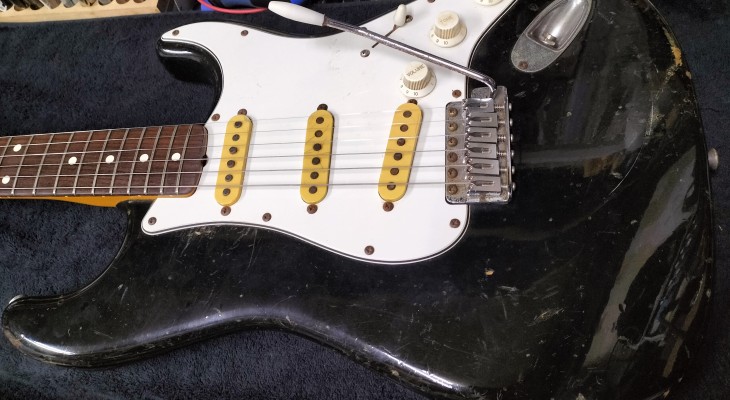
This is a nut replacement for an old Japanese vintage, JV serial Stratocaster made by Squier.
The nut is worn out and the open strings are jammed, forcing the guitar to be used in forward warp.
The fret wear was very severe, but the sound was not clogged, so we decided to hold off on the consultation.
We were able to replace the nut and adjust the instrument to a problem-free state.
Nuts and frets are very important parts of an instrument.
If there is a problem with this part, the performance of the instrument will be considerably degraded.
This is a Boden7 setup made in Strandberg. This model was made in Japan.
It is hard to play due to the forward bow.
The truss rod has been adjusted to make it easier to play, but there is no room in the truss rod.
The neck grip is a special neck grip shape and headless model, so it will be hard to tell how the neck condition will change over time, but I believe that it will warp in the same way as a normal instrument.
In particular, due to the special neck grip shape, the neck strength may not be consistent, which may lead to not only warping but also swelling.
I think more time will pass and more data will be gathered in this area.
I feel that the neck strength is also high, but in this case, the truss rod has a small amount of excess, so it is natural to loosen it, but if there is a large amount of excess, is it OK not to loosen it? And is it OK to leave the strings taut all the time? If so, it is basically safer to leave the strings loose because you don’t know what will happen in the future.
As long as the strings are loosened, there is no risk, so it is just a hassle, but if you think about the longevity of an expensive instrument, it is a task that can be done normally.
This is a pickguard installation and setup for a Gibson Les Paul.
This guitar does not have a pickguard, so we installed a pickguard brought by the customer.
The guitar is in a hard-to-play condition due to the large forward bow.
The neck was broken and the truss rod was not working properly.
The truss rod could be fixed by adjustment, but there is some concern about the truss rod.
The truss rod is not well set up, and the rod T-joints inside the truss rod may not catch properly, or it may come out when the nut is tightened, so please be careful.
All old electrical parts have been replaced with new ones.
We recommend replacing used electrical parts that are worn out.
Deterioration simply makes the sound worse, so it is better to replace old parts.
After replacement, the sound is noticeably thicker.
As the parts deteriorate, the bass, which is related to power, will be cut off, and the sound will become thinner as it wears out.
The change is so slight that you may not notice it, but if you replace the old one with a new one, you will be surprised at the change because it seems like quite a big change.
The sound is good, the rear is soft and manageable.
It is obviously a good unit. I’m not sure if it’s just a coincidence or if the last model from the factory is really good, but sometimes manufacturers have a “good time” like this.
The rear volume pot has been cleaned up with a contact resurrection agent.
The boxed model is easy for dirt to get into the control parts, so basically, you need to keep it closed in the case when you don’t play it, otherwise it will be easy for the buzzing to occur.
This is a broken neck repair for an Epiphone Les Paul Junior.
It is broken from the scarf joint.
This kind of breakage and peeling used to be common in the past, but it is still common in recent years, so you can be sure that this is a structure that is prone to problems.
This is a part where gluing accuracy is affected due to the small surface of the wood, so we tried gluing it back together, but it was fixed without any problems.
Basically, instruments are not manufactured to be shockproof, so be careful not to knock or bump them.