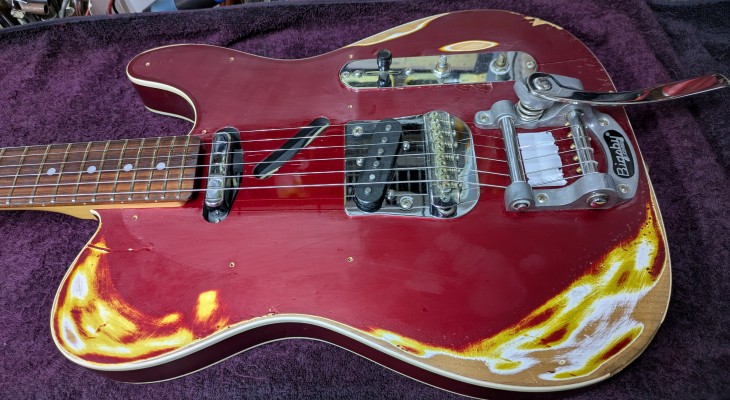
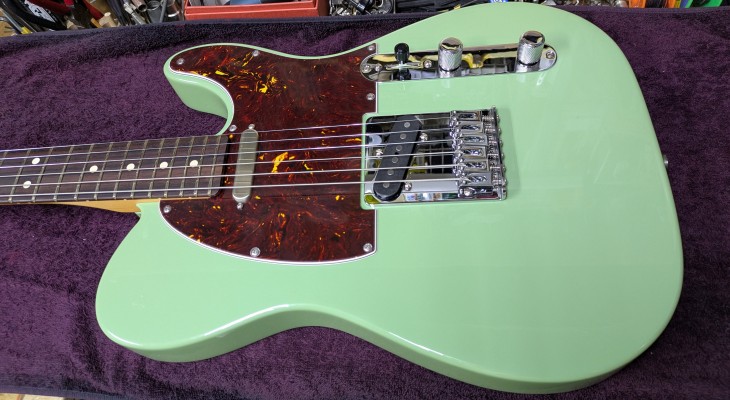
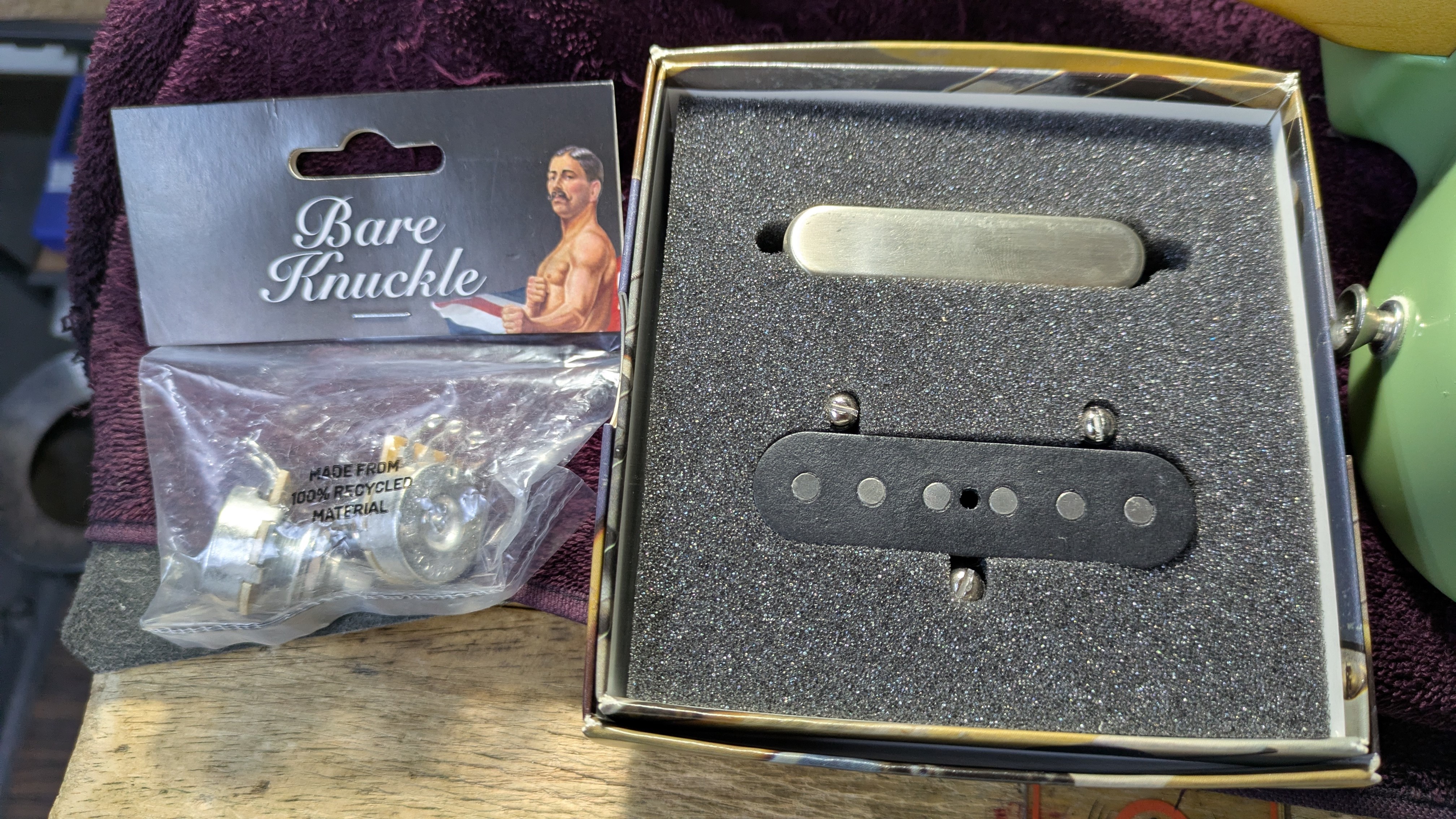
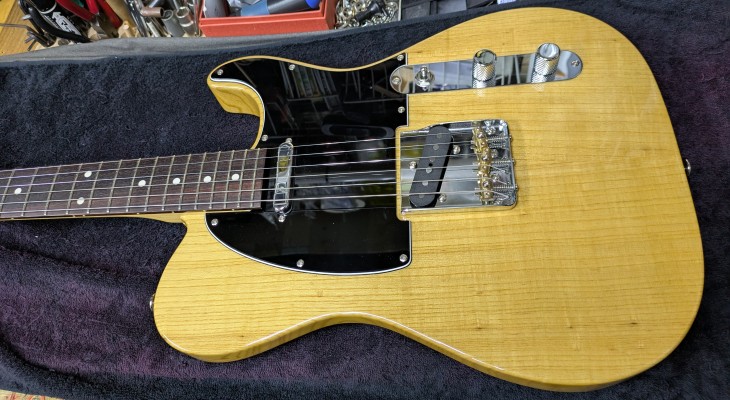
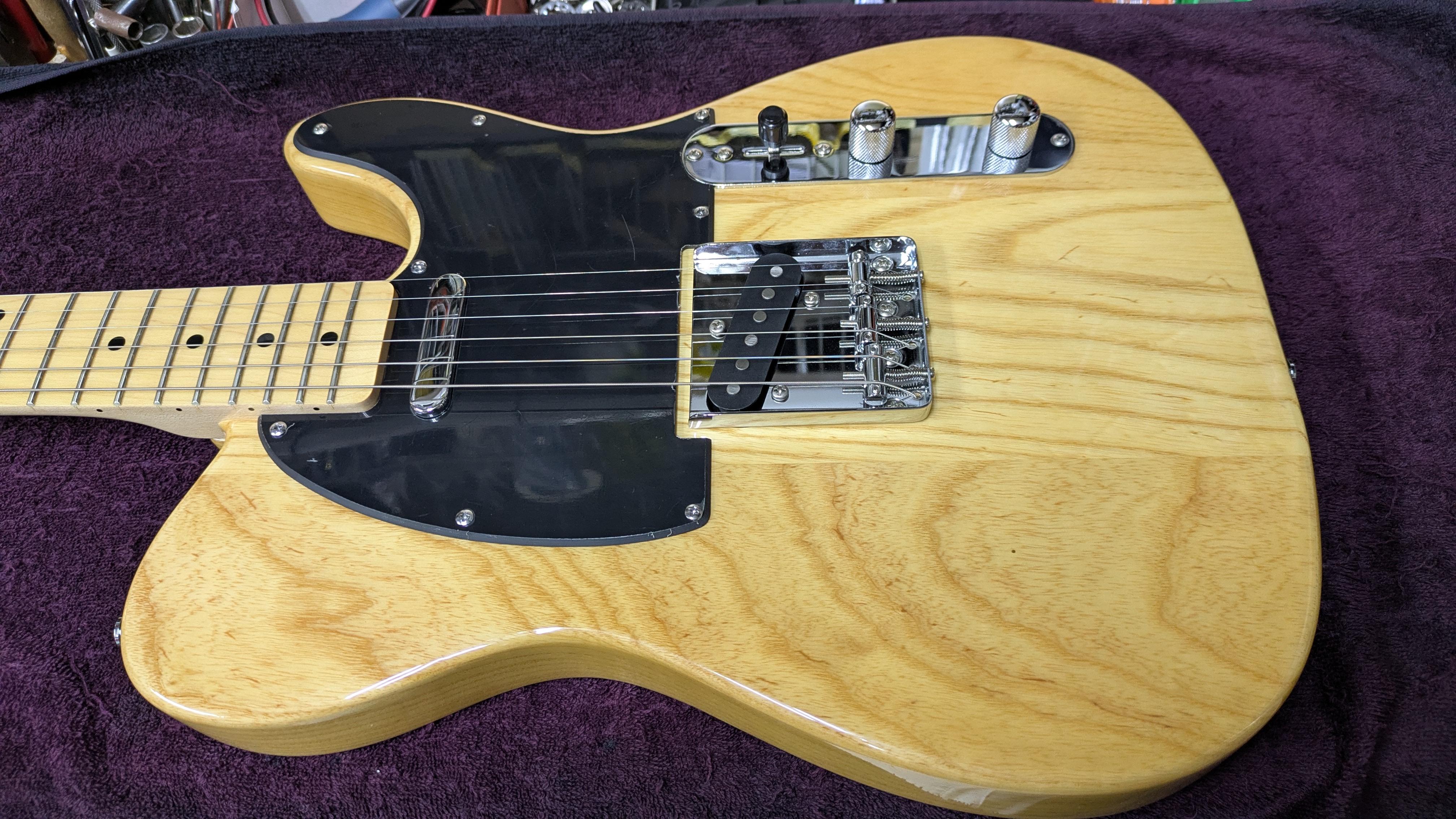
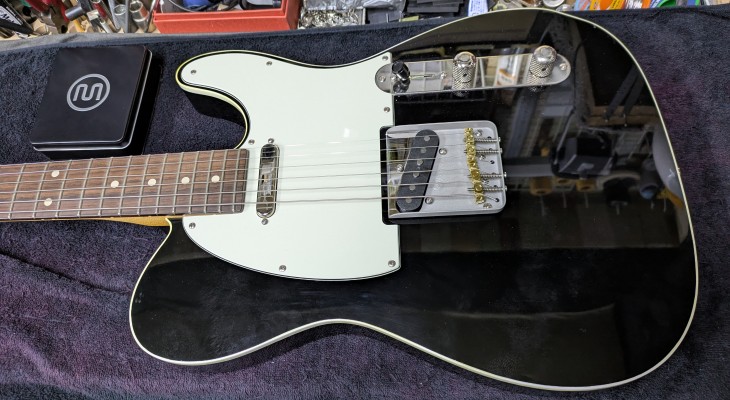
This is a pickup and pot replacement and setup for a Fender Mexico Telecaster.
We replaced the pickups with Bareknuckle Nomads provided by the customer and swapped out the pots for Bareknuckle 280kΩ units.
Since these pots have a slightly higher resistance than the 250kΩ pots typically used with single-coil pickups, the sound may lean more toward the high end compared to standard pots, which might give the impression of better clarity.
The front pickup produced a clean, well-defined tone with crisp articulation—no muddiness at all.
The bridge pickup offered a sound slightly fuller than a standard single-coil, with excellent balance.
It didn’t sound harsh or produce any ear-piercing high frequencies; when distorted, it delivered just the right amount of body and excellent distortion.
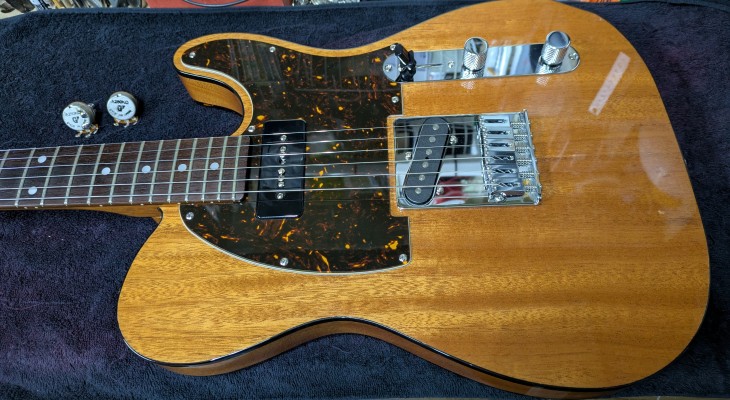
This is a rewiring and setup job for an All Parts Telecaster.
The neck is significantly bowing backward, making it difficult to play.
This is a component guitar built with an All Parts neck and body.
We replaced the bridge with a GOTOH TL-Classic provided by the customer and swapped out the wiring.
We also rewired the pickups using the customer’s provided wiring and replaced the selector switch with a 4-way selector.
The Telecaster’s 4-way selector adds a series connection for the two pickups, enabling a high-output mixed sound.
The result is a Telecaster with a generally softer tone.
The exact details of the wiring are unknown, but it might be Western Electric wiring sold by Pro Cable—I’ve used it before.
While wiring sold for audio speakers can be used for internal guitar wiring, the gauge is completely different. Since thick, stiff wiring can be forced into the routing channels, potentially causing problems, use it at your own risk.
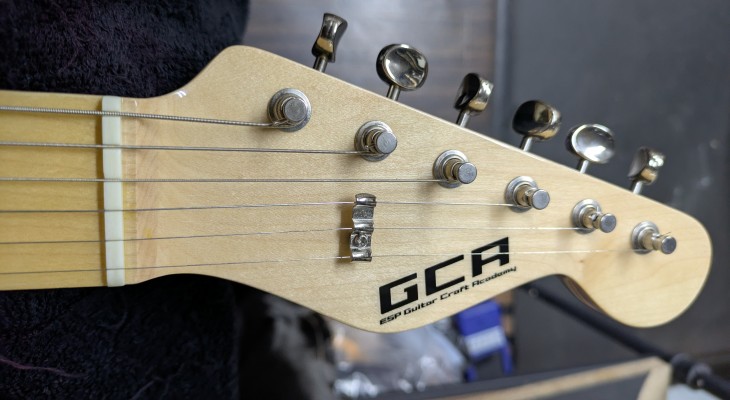
This is a guide to replacing the tension pins on the experimental Telecaster featured on YouTube.
The fact that “parallel-headstock guitars require a tension pin for the 3rd string” still hasn’t caught on at all among the general public.
As a result, there’s significant variation in tone, and chords sound bad.
Furthermore, the pressure on the 3rd string’s nut becomes extremely weak, so the open string doesn’t ring out fully—which only exacerbates the differences in tone between the strings.
To avoid this, a tension pin is needed for the 3rd string, but since most manufacturers lack technical expertise, very few have attempted to fix this issue.
Fender started installing tension pins on the 3rd and 4th strings in the 1980s, but it’s a mystery why they stopped doing so.
While a tension pin isn’t necessary for the 4th string, it is essential for the 3rd string.
In recent years, tension pins compatible with strings 1 through 3 have become available, and simply using these can significantly improve the sound.
The sound of the 3rd string becomes tighter and more resonant.
Simply put, the pressure on the nut—which the 3rd string previously lacked—increases, allowing the string to ring out fully and balance the tone with the other strings.
In particular, while the adjacent 1st and 2nd strings come with tension pins as standard and resonate fully, the 3rd string not only fails to resonate fully but also stands out negatively because it’s louder (due to improperly adjusted pole piece heights).
Since this issue with the 3rd string is completely eliminated, please replace your tension pins immediately with ones that work for the 3rd string as well.
They cost only about 1,200 yen, and this alone will improve the sound.
The tone will match that of the 1st and 2nd strings, and your chords will sound better.
You can see in the video how tension pins change the sound, but to be precise, what’s important is “applying the proper string tension to the nut.”
Please understand that this nut (contact pressure) is a major factor affecting the sound.
This also explains why the sound on Jaguar and Jazzmaster models can be poor; since the string tension on the bridge saddles is too weak, the strings don’t resonate fully, making a buzz-stop bar essential.
Remember that this contact pressure is essential for both the nut and the bridge; if it’s insufficient, the strings won’t resonate properly, leading to poor sound quality.
This is a pickguard replacement for a Squier Telecaster Custom.
This time, the work consists solely of replacing the pickguard.
Although the screw holes were misaligned, the misalignment was minor enough that it could still be installed, so after consulting with the customer, we decided to install it as is.
When replacing a pickguard, it’s best to assume that the screw holes will be misaligned.
If a screw hole is misaligned by even half its diameter, it’s best to fill it and drill a new one, but honestly, it’s possible to force it in.
Since this is primarily a cosmetic issue, you can choose to fix it if it bothers you, or simply ignore it if the pickguard fits—either approach is fine.
As long as the pickguard is secured by screws in multiple locations, it’s okay to skip screwing it into holes where the misalignment is significant.
As long as the pickguard is secured well enough to avoid any issues, it won’t affect your playing.
This is a model with great sound; Squier is a brand I highly recommend because it delivers excellent tone despite being in the lower price range.
The customer brought in the guitar, and we replaced the pots with CTS ones.
It originally came with Japanese-made pots, and although I’ve adjusted this same guitar many times over the years, simply changing the pots made the tone fuller and improved the sound projection.
Japanese-made pots aren’t bad, but with electronic components, performance often correlates with price.
Sound is ultimately a matter of personal preference, but with electronic components, higher-priced parts tend to produce better sound.
You can choose wiring and other materials based on your preference, but when it comes to pots, I think it boils down to a choice between CTS and Bones.
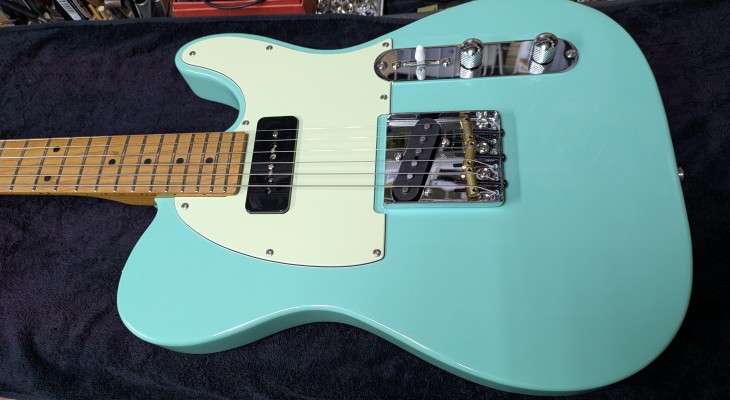
This is a Bacchus budget-friendly model—a Telecaster—that underwent tuner and nut replacements, fretboard finishing, and rewiring.
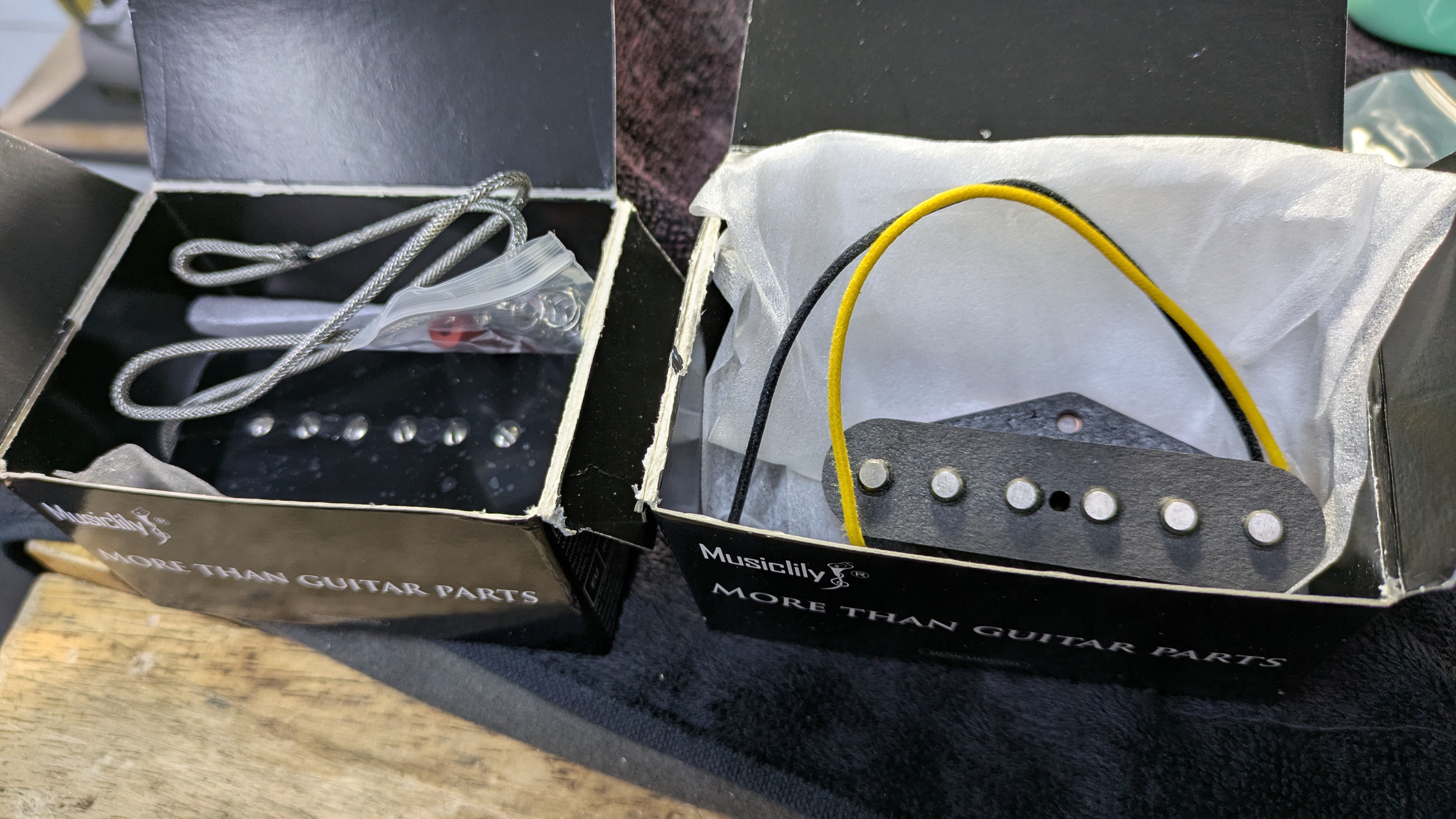
We upgraded it with a MusicLily pickup and electronic components provided by the customer.
We replaced the tuners with matching GOTOH models.
We also replaced the nut with a MusicLily cowbone nut provided by the customer.
Please note that while some online sources claim this nut fits without modification, it actually requires some adjustment.
Although this is a model priced at around 23,000 yen, it has solid basic potential. With these upgrades, I believe it now rivals guitars in the 200,000 to 300,000 yen range.
The front pickup’s sound is now closer to a Gibson-style tone, with a nice, full body that’s been slightly cleaned up from its original boomy tendency.
Another advantage of this pickup, unlike the Gibson P-90, is that the pole piece height can be significantly lowered.
With the Gibson P-90, the pole piece height can only be lowered to a limited extent, which often causes issues when adjusting the volume balance between strings.
With great sound and high flexibility in pole piece height adjustment, I highly recommend MusicLily’s pickups, even though they’re budget-friendly.
The bridge pickup isn’t overly bright; while it has a slightly reduced high-end response compared to a standard Tele, it tends to have a fuller tone. This makes it a great replacement option if you find the stock bridge pickup too harsh.
Even budget pickups can deliver a very usable sound these days—it really shows that we’ve entered an era where even affordable gear can be top-notch.
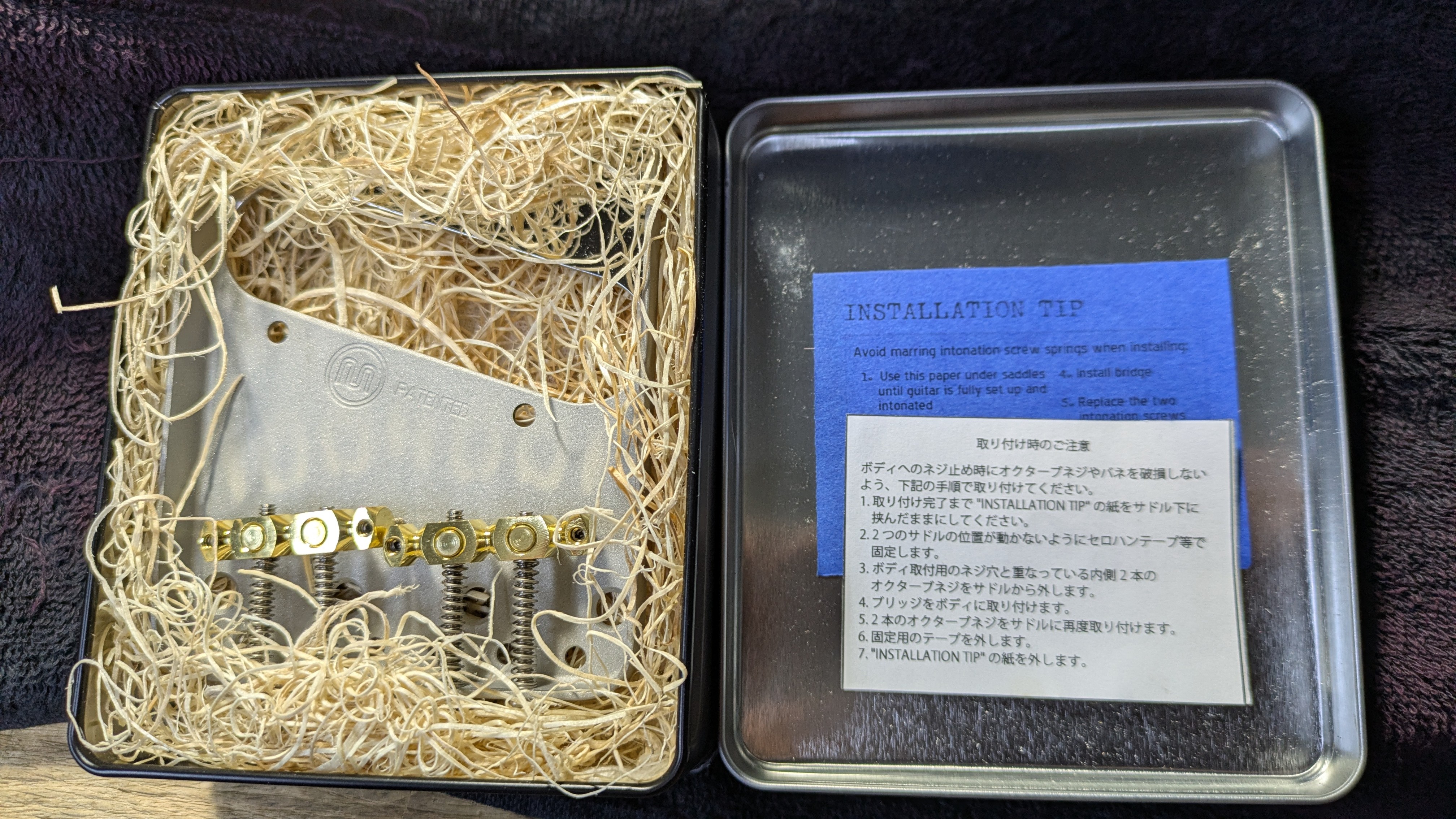
I’m upgrading it to a Mastery bridge—a modern-style bridge.
This bridge features two saddles, each supporting three strings, and the octave position is adjusted by tilting the saddles.
After the replacement, the tone became fuller and the separation improved.
It’s a fantastic Telecaster with a touch of acoustic guitar character.