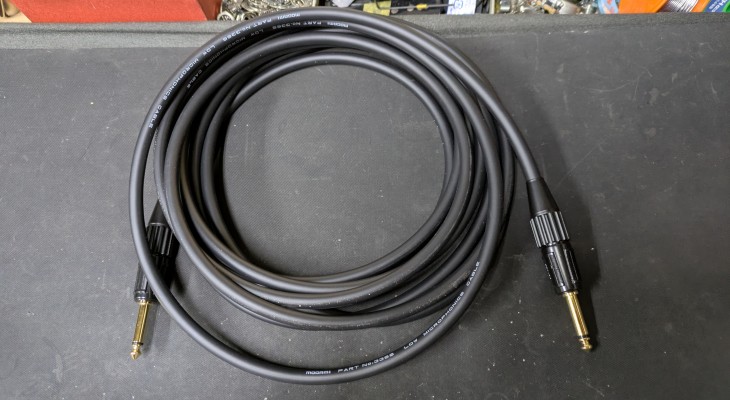
This cable has been recommended for a long time and remains quite popular.
Previously standard cables like Belden have become expensive due to price increases. Despite their high cost and reputation, their sound quality isn’t exceptional, leading more people to switch.
Using FP-703 for manufacturing results in a cable with even better sound quality.
Whether for guitar or bass, or even when used with an amp, it delivers excellent sound quality. It’s a versatile, affordable cable suitable for any application, so I highly recommend it.
While it’s become a standard, the 3368 equipped with Fulltec FP-703 connectors delivers significantly improved sound quality.
It produces a good flat response without introducing major sound variations, resulting in an easier-to-handle sound compared to other cables.
Significant sound variation makes tonal control difficult. Since absent frequencies cannot be produced, it creates pronounced sound imbalances, which is a negative.
The 3368 minimizes such sound drawbacks while remaining affordable and durable. Therefore, using the 3368 as the standard choice is likely to become the norm.
For musical instrument use, the 3368 has always been my top recommendation and is perfectly sufficient.
Cables from other manufacturers are simply too expensive.
The 3368 offers a well-balanced frequency response and excellent sound quality. Since cables are consumables, it’s fair to say the 3368 is virtually unmatched in delivering great sound at a low price.
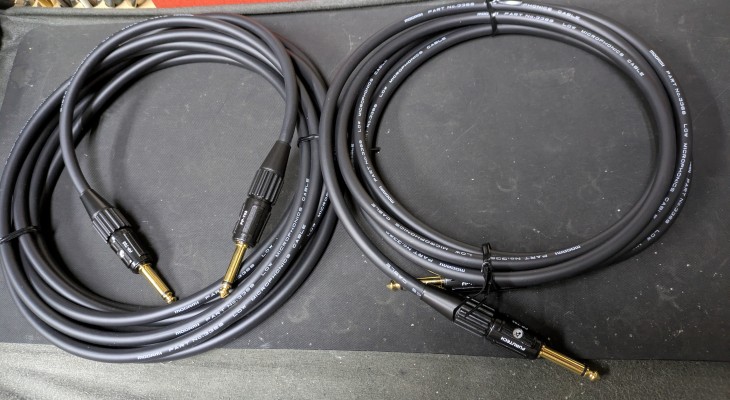
This particular cable was rebuilt due to customer error, including repairs. The customer provided the parts, and we rebuilt it from scratch.
This was another good learning experience for us, but faulty parts (like those subjected to excessive soldering heat) degrade the sound.
Also, L-shaped connectors sound worse. We’ve always used straight connectors exclusively because L-shapes drop the sound quality by a notch.
The overall sound is on the thicker side (a bit muddy), so to achieve good sound, selecting quality materials is essential, and soldering technique is also crucial.
We are requesting the production of three 5m cables and one 1m cable.
This cable is becoming a standard as the most cost-effective cable.
Cables in the world have become a business for the weak-minded, and it is a field with a business model where expensive cables that are not good at all are advertised by famous artists and media without hesitation, and people who do not know about them lose money by buying them.
Good sounding and strong cables are usually available in the low price range, and basic cables made by Mogami are sufficient in terms of performance.
Also, although FP-703 plugs are expensive parts, it is better to spend money in these areas.
Since many of the finished products on the market have cheap or ordinary plugs, it is better to make your own plugs or have them made for you, which will cost less than buying a finished product of the same length.
As the term “audio occultism” suggests, it is easy to be deceived by excessive advertising in the field of cables, so be careful.
The sound quality of the 3368 is good and well balanced, so it can be used for all kinds of music.
First of all, it is amazing that the sound quality can be changed so much just by processing Kurumira plugs alone.
It is true that the impact may be low, but the level of change shown in the video can be achieved with only two plugs, so if the number of plugs is increased, the effect will be significant.
The effect of adding Kurumilla-processed parts to instruments and equipment gives the impression of “strengthening the original sound.
This makes the signal from the guitar clearer and stronger, and makes it harder to be defeated by the distortion effects of the effects pedals and amp (the sound is less mangled), resulting in a lower distortion level.
We have not changed the settings of the amp or effectors, so you can better understand this area in the explanation.
The benefit of the Kurumilla processed parts is a guess at this point, but I think “the more equipment you have, the more effective it will be.
The more equipment you have, the weaker the guitar’s signal becomes, the more vulnerable it is to noise, and the more messed up the sound becomes, so in the end you will either have to control it better or reduce the number of equipment.
This is not a problem, and since the original sound is strong, it will be easier to add to the original sound, and it will be easier to add to the original sound.
It is difficult to cover the entire range with only two plugs processed with Kurumira, so it should be possible to send a strong signal to the amplifier without loss by increasing the number of plugs depending on the equipment to be used.
For example, if a cable with a Kurumilla-processed plug is connected from a guitar to an effector, and if there are about 6 effectors in use, the Kurumilla effect alone will probably destroy the signal around the end.
If you add cables with Kurumira processed plugs from around 3 effectors, or use cables with Kurumira processed plugs from the effector outlet to the amplifier, you can reduce signal loss by adding Kurumira processed parts at the points where the loss is compensated for.
Kurumira processed parts will be useful for players who use many effectors and digital devices such as multi-effectors to prevent sound quality degradation.
This cable gives the impression that it is no longer the standard shield cable for guitars and basses.
Since Mogami itself is a good manufacturer, there is no reason to buy other brands because of its good sound and low price.
Strangely, it is also a mystery that it seems not to be treated as a front in the cable world for a long time.
After all, even if they sell well because they are cheap and good, there is little profit, and if they become known, people will continue to use them and expensive cables will not sell well, so the industry does not publicize products that are inconvenient.
In the end, the industry will not publicize products that are not good for the industry.
I would recommend using 3368 as a basic cable because it is a good cable that is strong and does not have a big bias in sound.
This is probably the strongest cable that can be carried outside any longer.
Cables are consumables if they are used in a moving environment.
If the cable is to be used indoors in an immobile environment, it is possible to buy a good cable even if it is expensive, but it is difficult to buy an expensive cable for a consumable product, so a good cable at a low price is ideal.
The ideal model is Mogami 3368.
Basically, this model is the best choice for cables.
Other manufacturers’ products are expensive but do not have great performance, so 3368 is the most cost-effective cable.
We can also make cables if you bring in your own parts.
Especially, FP-703 made by Furutech is good for the plug. If you are going to make a good cable, it will be better to use a 703 plug.
If you are on a tight budget, you can use Neutrik plugs.
However, since the cable is 8mm in diameter, you will need to prepare a separate connector for 8mm when using the Neutrik plug.
The 3368 is well-balanced from low to high frequencies, so basically this is sufficient for a cable.
The cable industry sells cables that are not that good by over-promoting them and making them look like they are good.
Be careful not to be fooled.
Good sound can be achieved at a low price.
This is a request for the production of Mogami 3368.
This is the strongest cable for musical instruments with good sound.
The low price makes it both easy to handle and good sounding for a consumable cable, and honestly, I can’t think of anything else.
The cables in the world only seem to be misleading with excessive advertising, and they are all expensive but not that good.
I have no problem using Mogami cables for basic applications, but for instrument use, as long as you have 3368, there is no cheaper and better cable than this one.