The frets are rusted overall.
In addition, the sides of the frets are slanted over a wide area, and the 1st string is close to that line, so it may be prone to string drop.
Gibson’s quality varies greatly, and even high-priced models can be in very poor condition, so be careful when purchasing.
Additionally, the bridge appears to have been replaced, resulting in a significant difference in string height compared to the fingerboard radius, and there is also significant variation between the strings.
This was an individual with poor overall finish quality.
We performed fret leveling to remove rust and improve the condition.
While we could not completely reset the extreme diagonal slope of the fret sides without risking the frets disappearing entirely, we believe the guitar is now playable without issues compared to its original state.
After adjustment, the sound is no longer muffled and the guitar is easy to play.
The Ibanez SR series offers excellent value for money, with many models that are easy to play and produce great sound, even at lower price points.
Even models costing several thousand dollars perform well in use, and those with active circuits offer excellent sound quality and are easy to customize, making them highly cost-effective.
This is a nut replacement, fret leveling, and selector replacement for an Ibanez Iron Label 8-string RG.
The nut was worn out, causing sound blockage, and the frets were floating and the neck was warped, also causing sound blockage.
The selector was worn out, causing sound issues, and the instrument was in pretty bad shape overall.
We replaced the nut, leveled the frets, and replaced the selector with a new one, bringing the instrument back to a problem-free condition.
With such severe wear, I believe the playability improved significantly after the repairs.
With fretboard frets, it is possible that the manufacturer produces fewer units, so the precision may be poor from the start.
Therefore, it is important to consider that even new instruments with fretboard frets may not be in good condition.
That said, even new, high-priced instruments may have issues from the start, so it is not unreasonable to consider repairing the nut and frets after purchase.
Mahogany is a soft wood, so it tends to bow forward easily. If you have been using it for many years, you should adjust it annually.
We have adjusted it to make it easier to play.
This is a well-balanced instrument with good sound, thickness, and projection.
Even in Gibson’s lower price range, there are many instruments with excellent sound quality, so price is not a factor.
In fact, it seems that there are more instruments with good sound quality in the lower price range these days.
This is a peg replacement and setup for a History Premium Series Stratocaster.
This is a model manufactured by Tsubasa Guitars.
The pegs are being replaced from lock-type pegs to regular pegs.
Those who are knowledgeable about guitars realize that lock-type pegs are not as good as regular pegs in terms of sound, so some people choose to revert back to regular pegs.
The Premium Series, manufactured by Tsubasa Guitars, offers the same playability and sound quality as Flatoon and Tsubasa Guitars.
This is a rare find even in the used market, but truly excellent instruments rarely circulate in the used market, so this model is definitely worth snapping up if you come across it.
Moon guitars were highly regarded for a time and were often used by skilled players, but in recent years they have become less common.
With some adjustments, I was able to make it easier to play.
The sound is excellent, with a vintage-style tone from the front pickup that has a rich, full-bodied quality, yet it also has good projection and volume, making it much easier to handle and sounding better than Fender-style guitars.
The volume balance between the front and rear pickups is also good, so these domestically modified models tend to be better in terms of usability.
This is a fret leveling for a G&L Tribute Series M-2000.
The sound is muffled, and the neck has significant warping.
It’s not that old of a model, but it’s in surprisingly poor condition.
We decided to address the issue with fret leveling. Due to the significant warping, a lot of material needs to be removed.
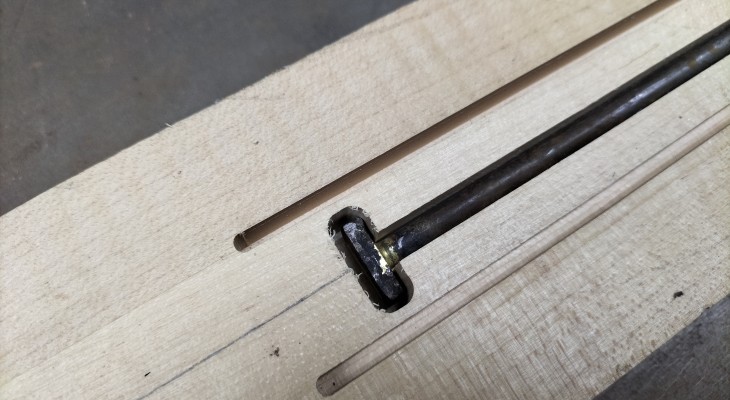
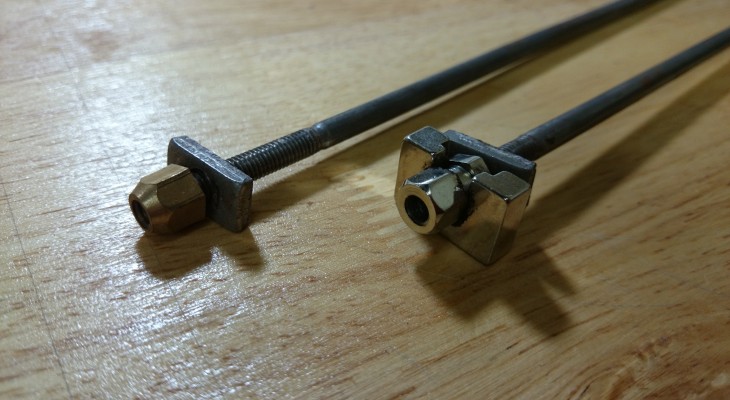
The truss rod is quite stiff and difficult to turn, with an unusual stiffness that may be due to the warping.
The truss rod has reached its adjustment limit.
Additionally, while the nut height was already high to begin with, the fret leveling process further increased the height.
If this is a concern during playing, a nut groove adjustment is necessary to lower the height.
Repairs are interconnected with other parts, so if you only want minimal repairs, we cannot do anything here. However, it’s better to think that “if you fix one part, other issues will become more noticeable.”
The neck was severely bowed, causing the sound to be muffled.
In this condition, it was very difficult to play, and the sound was muffled, making it impossible to use properly.
Even expensive instruments cannot be used properly if they are not properly adjusted.
We were able to adjust it and make it easy to play.
It was a model with good sound, and it had a well-played sound.
This is a fret leveling for a Fender Mexico Jazz Bass.
The neck is warped, causing the sound to buzz.
Wood used in recent years tends to be weak, so I think it is prone to warping and bending after prolonged use, and does not last long.
Also, considering the tension balance of the strings, it may be necessary to use D’Addario’s “Balanced Tension Strings” in light of the recent decline in wood strength.
Furthermore, using thinner gauges such as 45-100 is also not recommended.
For example, with 45-100 strings, this is a 5-string pack, but there is a difference of about 5 kg in tension between the 2nd and 4th strings.
Many bassists feel that the 4th and 5th strings are loose, but this is not just their imagination. They are actually loose.
Therefore, we have always said that bass strings are “too thin,” but poor tension balance also results in warping of the neck.
Balanced tension strings are designed to adjust the tension differences between each string to a uniform level, which should prevent warping.
This model also has a soft neck, so the curvature differs between the 1st and 4th strings. It’s important to understand the curvature caused by the neck’s softness.
This varies by individual instrument, but the 1st string side may have a forward bow or a reverse bow, and the 4th string side may have a forward bow tendency or a reverse bow tendency.
Additionally, the effectiveness of the truss rod may differ between the 1st string side and the 4th string side, so repairing such a weak neck not only requires repair but also adjustment, which increases the difficulty.